

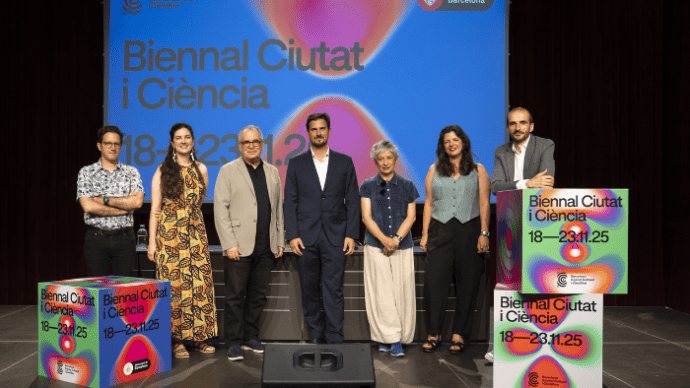
From 18 to 23 November 2025, Barcelona will host the fourth edition of the City and Science Biennial, an initiative of Barcelona City Council that aims to bring scientific research and reflection closer to the public through open, participatory and transversal activities. In this edition, the Biennial will focus on the impact of quantum science and technology, within the framework of the International Year of Quantum Science and Technology, declared by UNESCO.
For this edition, HacTe has been part of the curatorship of the programme in Barcelona, together with Toni Pou (physicist and journalist) and Alba Cervera (BSC). HacTe’s proposal has been worked on collectively through the recently created quantum group, made up of professionals linked to scientific, technological, artistic and academic institutions in the city. This group is made up of Lydia Sanmartí (ICFO), Sebastian Grinschpun (IFAE and BIST), Sergi Botella and Antonio Gagliano (Hangar), Pau Alsina and Manel Jiménez (UOC), Carme Fenoll and Giulia De Rossi (UPC), and Roc Parés, Teresa Roig and Raquel Bouso (UPF).
The curatorship of this edition proposes a plural view of quantum technologies, understood not only as scientific and technological advances, but also as an engine of imagination, thought and cultural practice. Through this approach, the Biennial will address the transformations derived from the second quantum revolution —such as computing, communications or quantum sensors— and will open spaces to collectively think about how these technologies can influence the narratives, social structures and forms of knowledge of the future.
The activities will be concentrated in El Born Centre de Cultura i Memòria, and will extend to other relevant spaces such as the Greenhouse of the Parc de la Ciutadella, the UPC-Ciutadella Campus and the Convent of Sant Agustí.
The complete program will be presented publicly during the month of October. A diverse offer is planned that will include exhibitions, conferences, workshops, artistic proposals, educational activities and spaces for debate, with the participation of leading figures from the scientific, philosophical and cultural worlds

