

Invisible Voice, by Mark Farid, is an interactive artwork that exposes the hidden infrastructures behind the websites and products we use every day.
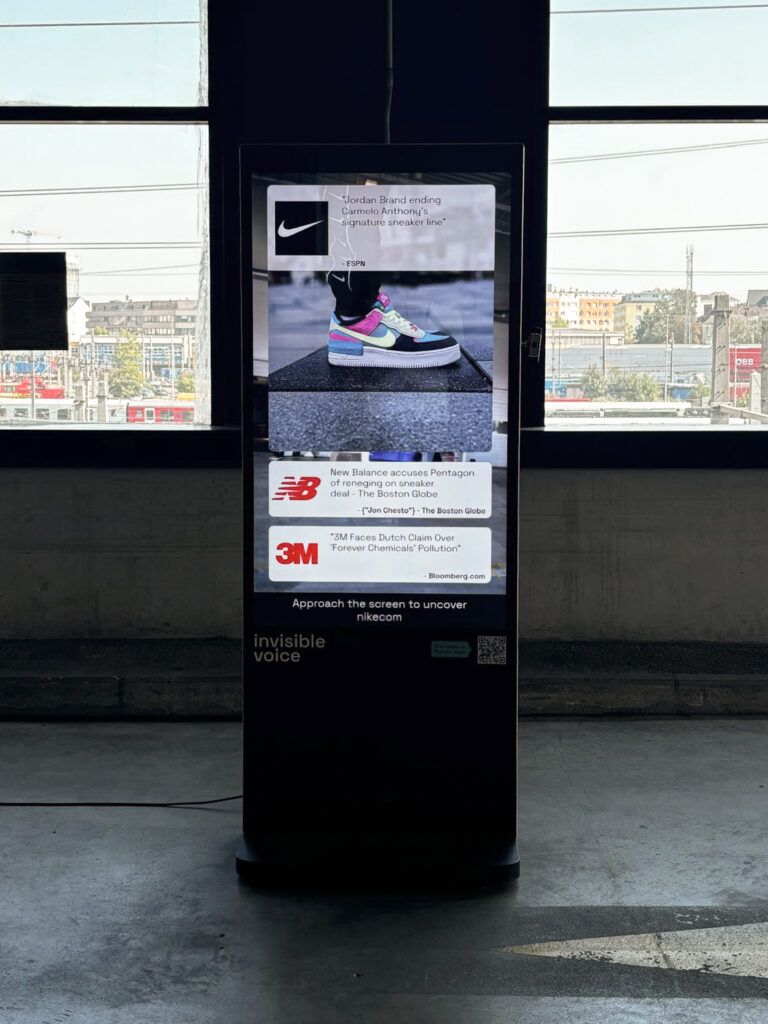
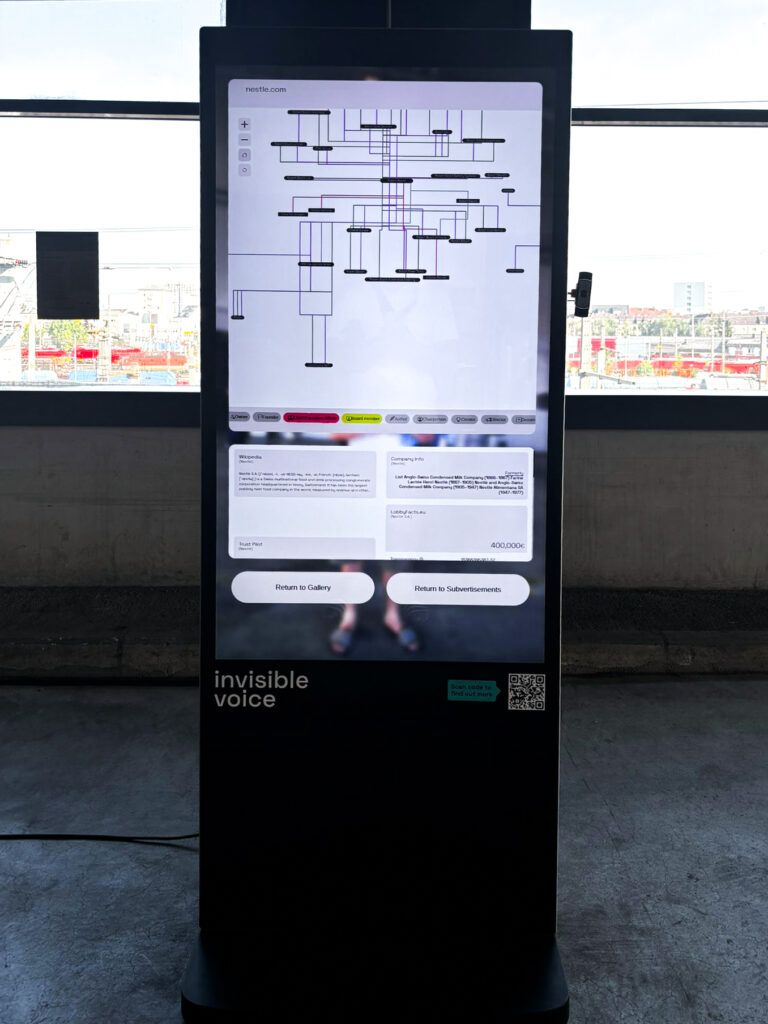
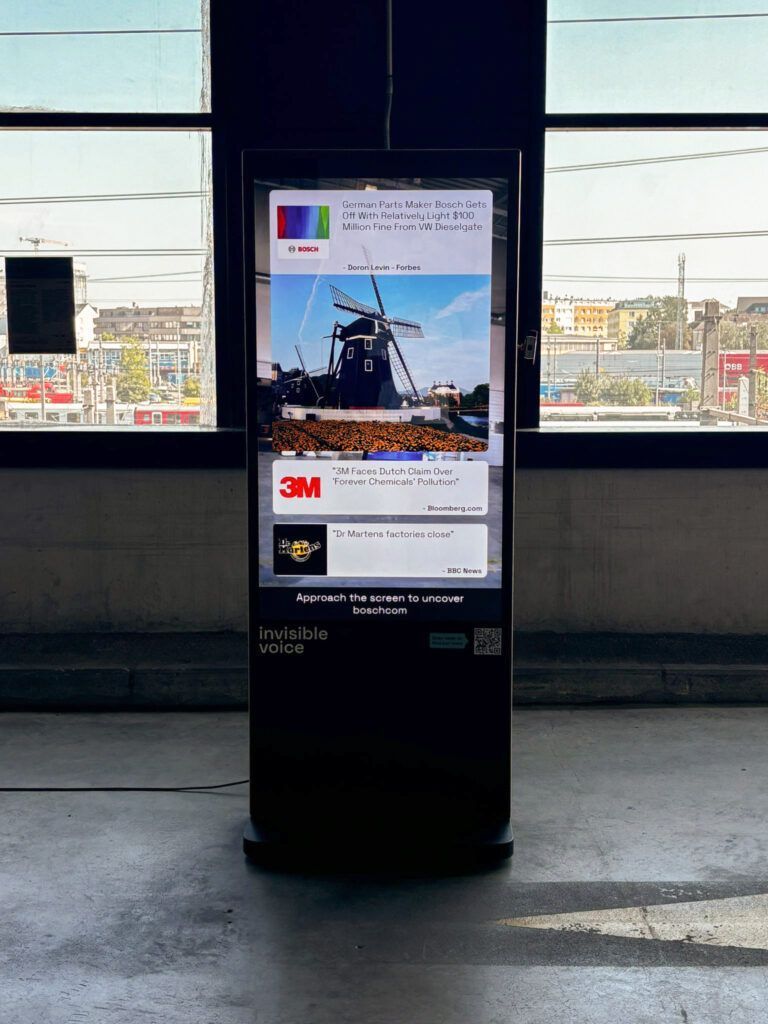
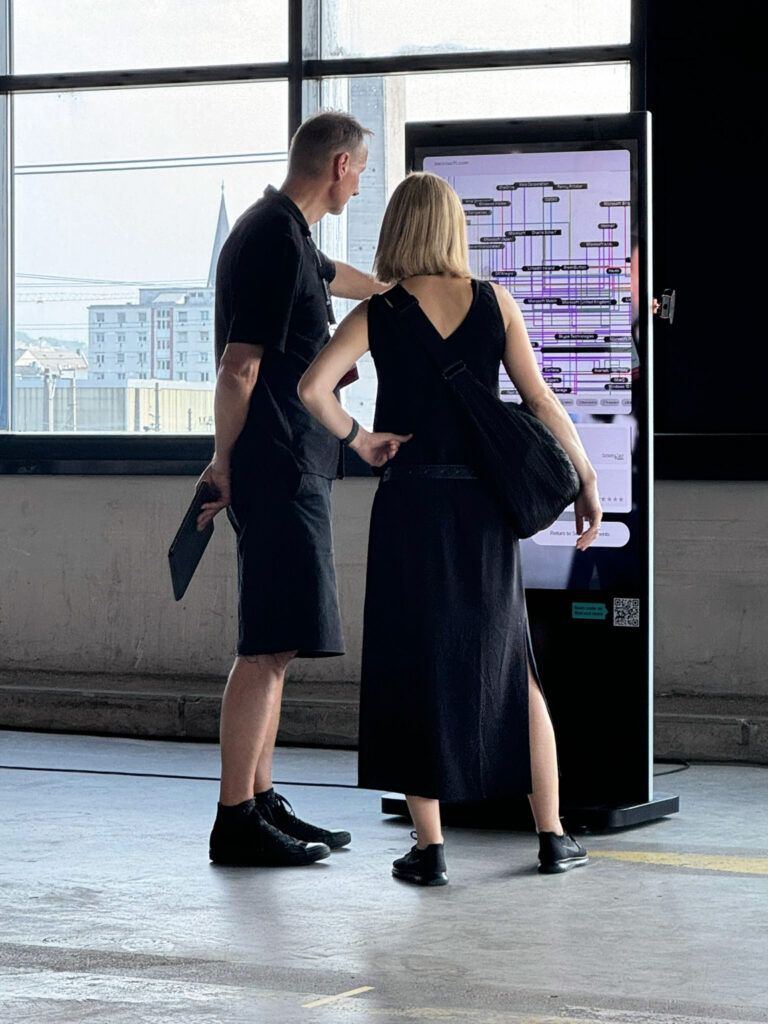
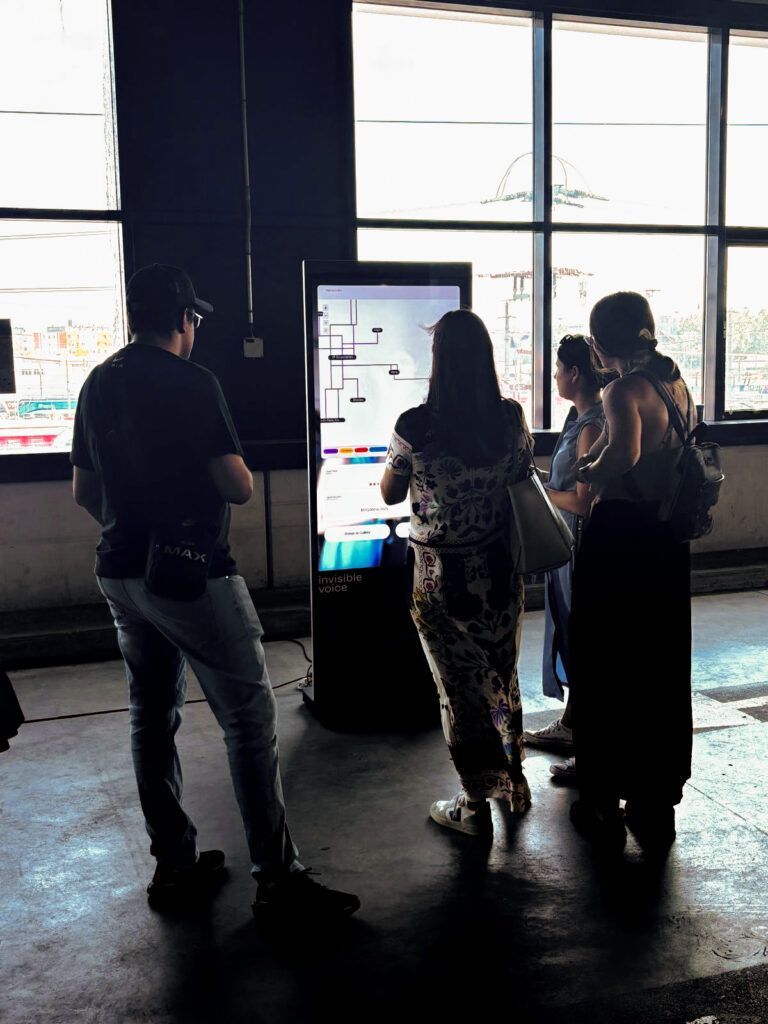
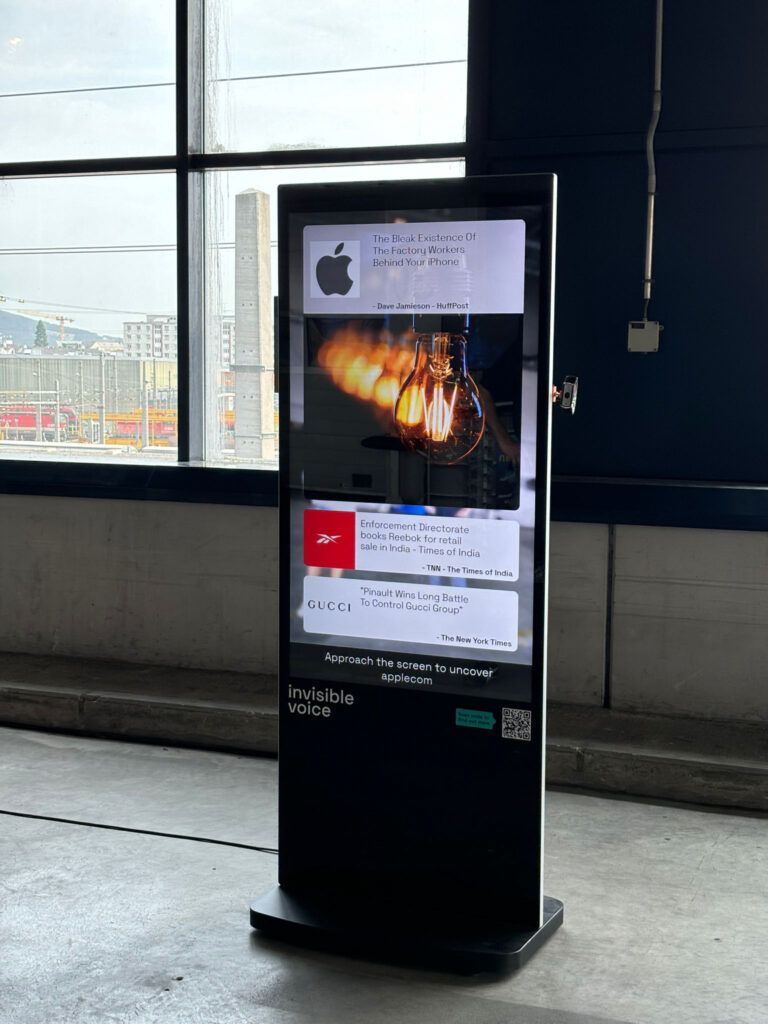
The installation features an advertising board equipped with custom sensor technology. As a viewer approaches, the sensor triggers an analysis to identify brands the person is wearing or carrying. These brands are cross-referenced with the Invisible Voice database (drawn from 38+ public datasets), and the screen displays relevant news headlines and images about those companies, creating a subvertising effect. Subvertisements rotate periodically until audience members approach the board, when the display switches to company-specific information—environmental impacts, corporate accountability, lobbying, financial conduct, political leaning, etc.—alongside a network graph showing the links between that company, other companies, and individuals.
The artwork is not a neutral display of information, but a critical lens: a shifting interface that allows audiences to encounter the hidden stakes of ordinary digital life and to recognise their own position within larger structures of power and responsibility.
Exhibited at: International Symposium of Electronic Art (ISEA), FR, 2022. Ars Electronica Digital Arts Festival, AT, 2024. S+T+ARTS Symposium, ES, 2024. Trafaria Digital Art Festival, PT, 2024. Filmed at arebyte Gallery, UK, 2025.al impact instead of profit, turning data into action and fostering local communities around specific causes.
“This project it is linked to a broader concept of sustainable development, visualises the interests of different companies and proposes a handy app to decipher the complex web of relationships between companies. And it has a good previous development that ensures the achievement of the goals of the project.” – Tere Badia
Mobile App
Invisible Voice is a free mobile app that reveals the ethics and business practices behind the products, services, and companies we encounter every day. Using a barcode or logo scan, the app cross-references 40+ trusted open datasets to surface environmental records, lobbying activity, political ties, ownership structures, human-rights practices, and corporate or government accountability. Unlike most responsibility tools, the information appears precisely where it is needed. A barcode scan reveals product specific supply-chain politics; a logo scan shows labour practices, gender-equality scores, political donations, lobbying influence and climate impact. Each company page includes a network graph mapping links to related companies, individuals and institutions, making complex infrastructures legible at a glance.
The app goes beyond transparency by offering clear pathways for action. You can choose to boycott or endorse, switch services, contact your MP, connect with NGOs, charities and legal resources, or support relevant campaigns at the moment of interaction. Built with a privacy-first approach, Invisible Voice minimises data collection and keeps your use of the app separate from personal identity. The app also supports collective action. You can form or join groups organised by issue or location, track milestones, and coordinate actions such as petitions, boycotts or fundraising drives. In this way, Invisible Voice functions as both a personal decision aid and a civic infrastructure, turning scattered acts into coordinated participation.
Browser Extension
The Invisible Voice browser extension brings the same capabilities to everyday browsing. As you visit websites, it draws on the same 40+ datasets to reveal political affiliations, lobbying ties, ownership chains, environmental impacts, financial conduct and media bias across more than 1.5 million sites. Company and organisation pages present scores and context with links to sources, a network graph of relationships, and routes to act. The extension is open-source, privacy-preserving, and available across major browsers, with a Tor-compatible version for repressive or censorship-heavy environments. It enables journalists, researchers, activists and citizens to cross-check narratives, uncover hidden affiliations and take action by supporting campaigns, contacting representatives, collaborating with NGOs or joining collective initiatives, without leaving the page.
Invisible Voice is commissioned by the European Commission, and co-commissioned by MediaFutures, and Open University of Catalonia, and HacTe, in the framework of S+T+ARTS in the City, and Horizon 2020, along with support from University of the Arts London and the GuestroomMaribor.
+ Artist
Mark Farid is an Artist, Researcher, and Lecturer in Fine Art at Central Saint Martins, University of the Arts London. He specializes in the intersection of the virtual and physical world, and the effect new technologies have on the individual and their sense of self. Farid’s work embodies hacker ethics, such as a focus on privacy policies, use of surveillance technologies, and campaigning for data privacy and protection. His work forms a critique of social, legal, and political models.
Graduated from Kingston University, London, with a First Class (Hons) degree in Fine Art (2014) and has since given talks and participated in group and solo exhibitions in England, France, Germany, Spain, Denmark, Finland, Slovenia, UAE, and Japan.
+ Credits
Artist: Mark Farid
Lead Developer: Orange
UX & UI: Tom Shearing
Invisible Voice is created by Mark Farid and developed by Orange. It is co-commissioned by HacTe and MediaFutures with support from the University of the Arts London, Universitat Oberta de Catalunya, and GuestRoomMaribor.
This project has been developed in the context of the S+T+ARTS in the City project. S+T+ARTS in the City has received funding from the European Commission’s Directorate-General for Communications Networks, Content and Technology under grant agreement No. LC-01984766.
S+T+ARTS in the City is funded by the European Union under grant agreement LC-01984766 under the STARTS – Science, Technology and Arts initiative of DG CNECT. Views and opinions expressed are those of the author(s) only and do not necessarily reflect those of the European Union or DG CNECT. Neither the European Union nor the granting authority can be held responsible for them.