

The Catalan and Spanish ASTS (Art, Science, Technology and Society) ecosystem has had a prominent presence at the Ars Electronica Festival 2025, held from 3 to 7 September in Linz (Austria). With the slogan “PANIC: yes/no”, this year’s edition explored how collective fears – from the climate crisis to authoritarian technologies – can be transformed into engines of imagination, resilience and democratic futures.
Within this framework, HacTe participated in the meeting of the S+T+ARTS Buen-TEK consortium, part of the European S+T+ARTS (Science + Technology + Arts) programme, and other meetings with other S+T+ARTS projects to strengthen alliances between the international members of the initiative and share experiences of transdisciplinary residencies. The closure of the S+T+ARTS programme as a result of the end of the current funding cycle of the European Commission generated a shared concern among the participants in the S+T+ARTS meetings.
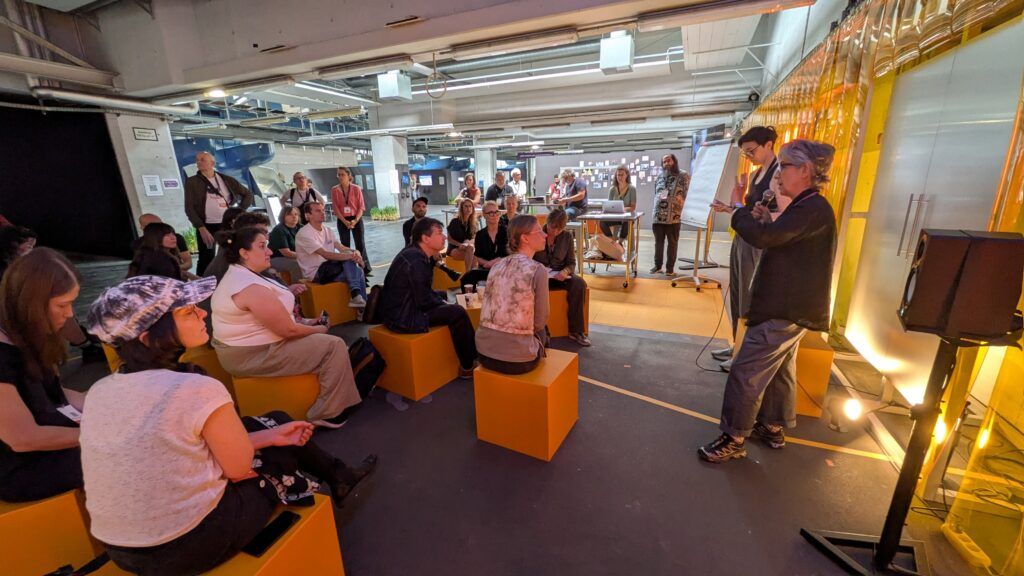
At the same time, redACTS co-organized a networking, connection and exchange session between agents and institutions operating in this field within the framework of the Townhall meetings, under the title Futuros ACTS en Europa: Redes y ecosistemas. In this space, representatives of European networks and institutions discussed the future and the need to connect and strengthen the ACTS ecosystem.
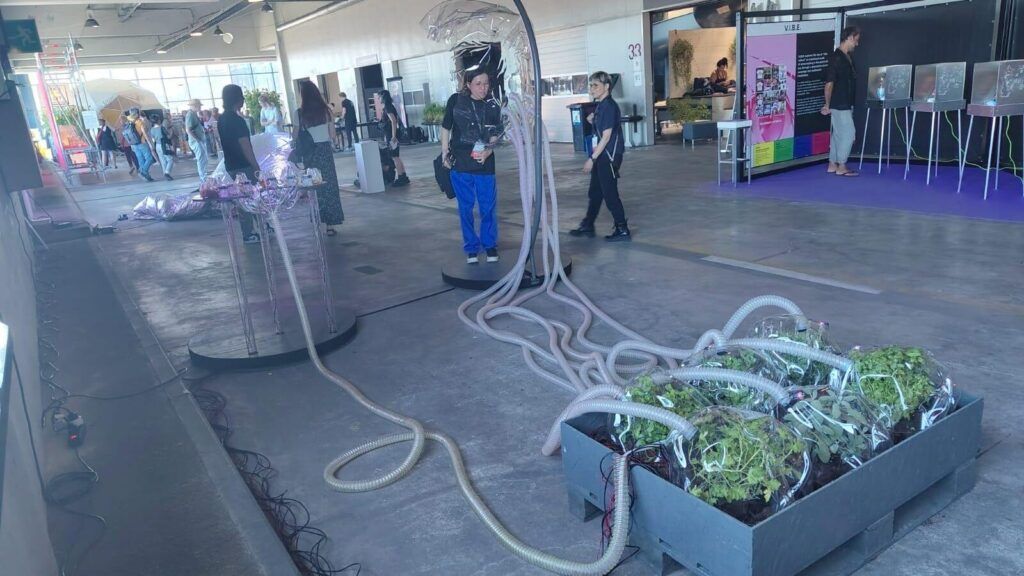
The Catalan presence was also visible in the exhibition field with the participation of the NewArt {foundation;}, which presented Chemical Calls of Care II by Yolanda Uriz, an installation that invites us to explore chemical-olfactory communication with plants, proposing “care” as an alternative to panic and opening paths for horizontal relationships between species. Members of the DARTS (UOC) and ReDISSENY and DICODE (UPC) research groups and the Sónar+D team also visited the festival.
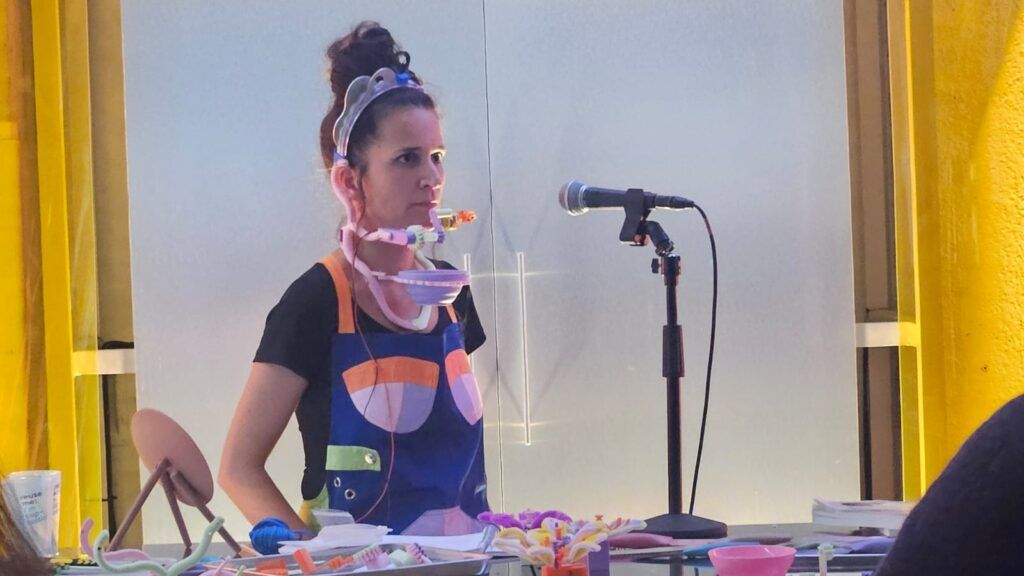
The Barcelona Supercomputing Center – Centro Nacional de Supercomputación (BSC-CNS) presented Expanded Voices, a proposal developed jointly with the artist Maria Arnal. The project explores how voice synthesis using AI can expand and question the boundaries between self, body and technology, from the latent space of artificial intelligence models: a multidimensional structure that encodes and compresses training data.
In addition, other artists and collectives from the Catalan and Spanish scene exhibited works at the festival, expanding this representation. such as Marc Vilanova, Santiago Morilla, César Escudero, Marta Revuelta, Noemí Iglesias Barrios and the Domestic Data Streamers collective, among others.
On the other hand, the artist Mónica Rikic showed the evolution of the Somoure project —the result of an S+T+ARTS in the City residency promoted by HacTe in collaboration with the Institute of Robotics and Industrial Informatics (IRI CSIC-UPC) in the Feeding the Future workshop where she addressed the debate on robotics and technology as care practices.
With these contributions, HacTe and redACTS reinforce their role as a pole of connection between art, science and technology, contributing to giving international visibility to Catalan and Spanish creativity and strengthening the networks that work to consolidate the ACTS ecosystem on a European scale.