

Promoted by HacTe, Hangar and einaidea, Tecnosi is a training program that focuses on technoscience, understood as the inseparable network between science and technology in the production of scientific knowledge, and its biopolitical ramifications.
This program is based on the creation of situations of coexistence and intensive learning, as an alternative to conventional academic learning modes, bringing together artists and researchers around research and production practices.
Tecnosi invites two artists to open the code of their work to offer a course structured around specific projects or artefacts and explore, on the one hand, the most vulnerable and sensitive areas of them and, on the other, the points of intersection between artistic, technological and scientific practices.
In this second edition, held on December 8 and 13, 2025, the invited artists were:
Agustina Woodgate (Buenos Aires, 1981) is an artist and researcher who investigates public and civic spaces through situated practices. It focuses on the study of systems, value theories and design logics that operate in the built environment and that shape society.
Antonio Vega Macotela (Mexico City, 1980) explores the notions of work, value and exchange, often in collaboration with communities and in specific places. With a particular focus on the system through which social relations are established and negotiated, he explores alienation within economic systems and their social structures.
We delve into the contents of this edition, synthesized from the complete report by Mar Gené and which makes up the documentary body of a future publication on Tecnosi.
Workshop with Agustina Woodgate – 8 and 9 December
The program began with an introduction where Woodgate located his artistic practice in overflow, dismantling and disobedience, as strategies to question the structures that shape our environment. Her work is located in the gray area between public and private space, exploring the specificity of place, bureaucracy, inefficiency and openness to uncertainty, to transform apparently simple gestures into political and poetic acts.
Specifically, Woodgate emphasized a methodology based on open, non-linear, and permeable processes to improvisation, in which failure becomes a tool to reveal tensions inherent in existing systems and explore forms of action against the current. The artist presented interdisciplinary collaboration as a central element of her work, articulated through negotiation processes, strategic mediation and a conscious management of roles to avoid extractive dynamics. In this context, art is developed as a collective pedagogical laboratory in which the value resides in the processes, conversations and activation of knowledge networks, rather than in the final object. The projects presented by Woodgate on this first day were, among others, The Source and More Heat than Light.
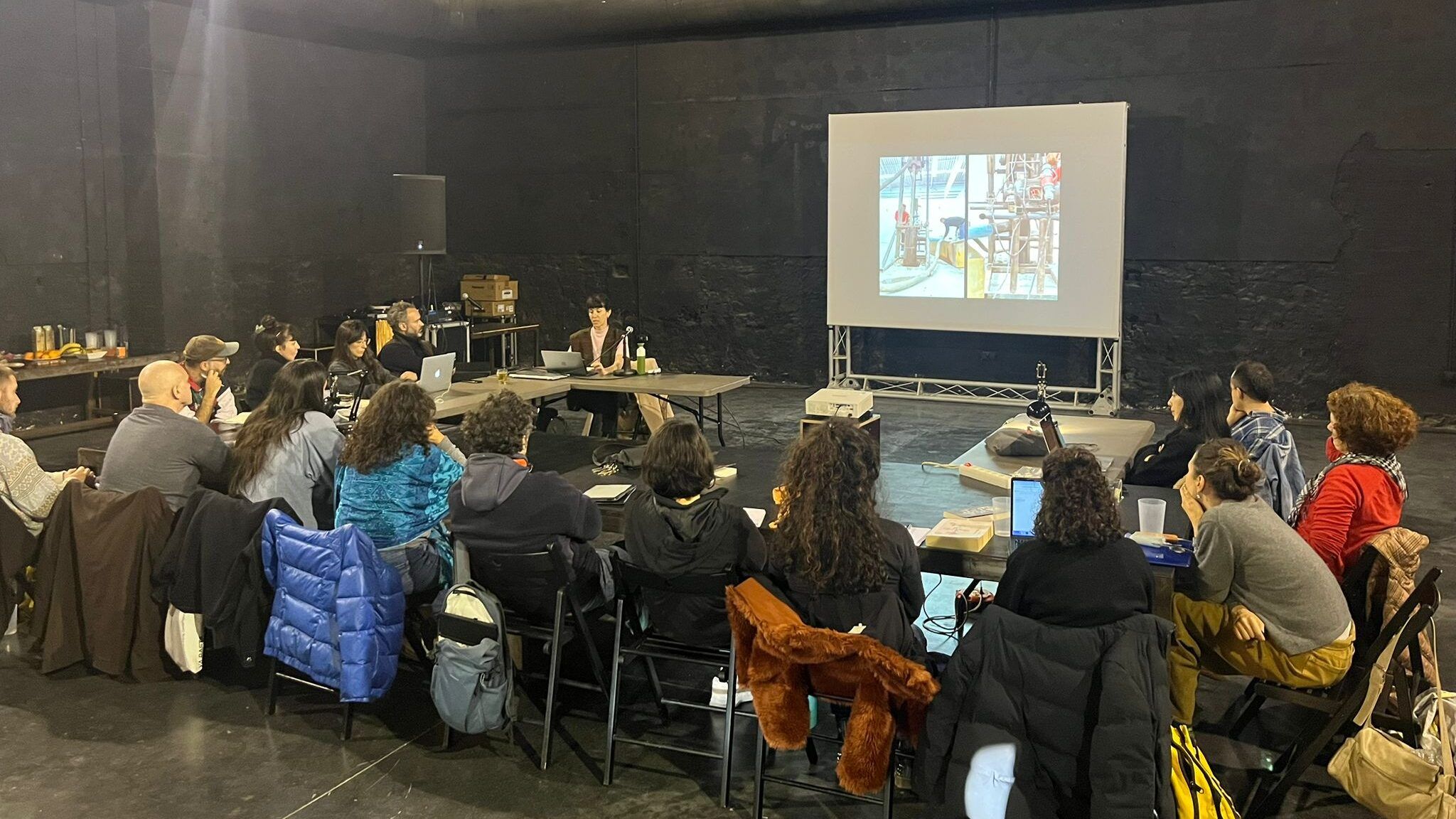
During the second day, Woodgate delved into the relationship between art, science and institutions, highlighting how artistic practice can operate in the interstices of systems to generate conceptual frictions and make often invisible structures visible. During the workshop, and in an open conversation with the participants, issues related to the maintenance, observation and subtle intervention of technical and institutional processes were addressed, as well as the importance of negotiating roles, responsibilities and forms of collaboration. In this framework, failure, patience and observation emerge as conceptual and tactical tools to activate new forms of intervention and knowledge.
Other concepts discussed were those of “countercurrent” and “overflow”, applied to both artificial intelligence systems and natural phenomena, to explore processes of accumulation, deaccumulation and latency understood as spaces for strategic action. The session concluded with a reflection on memory and trauma, the tensions between oblivion and hyper-memorialization, and inequalities in heritage preservation. Woodgate proposed design as a tool for critical reading capable of identifying structures, protocols and gaps in order to intervene strategically, understanding art as a space of friction that activates processes, knowledge and latent memories.
Workshop with Antonio Vega Macotela – 10 and 11 December
The workshop articulated a theoretical and practical reflection on the relationship between art, communication and technology, taking as a starting point the circulation of money, data and resources as control mechanisms. Based on the analysis of equivalence chains and exchange systems, Vega Macotela questioned the structures of economic alienation and the biopolitical excesses of technoscience, highlighting how these processes transform our notion of value. For the artist, art is conceived as a tool capable of unveiling and dismantling these systems through apparently absurd or displaced gestures that reveal the fragility of contemporary forms of control.
During the first day, Vega Macotela addressed the idea of concealment and preservation of information, exploring strategies to leave visible or invisible messages in different contexts, from physical spaces such as prisons to digital environments. Based on projects such as Time Divisa and Studies on Exhaustion, the artist presented exchange protocols in which drawing, documentation or everyday gestures become communication devices. The notion of “ghost” served as a metaphor for messages that circulate between worlds and require a material support to manifest themselves. The session also served to introduce the history of steganography, from Trithemius’ Steganographia to contemporary practices linked to hacking, memes and speculative literature, opening a debate on the preservation of information in the face of censorship, noise and manipulation. Within this framework, it was proposed that memory and affections can last beyond material supports and that art is capable of generating significant effects through ephemeral, subversive and playful actions.
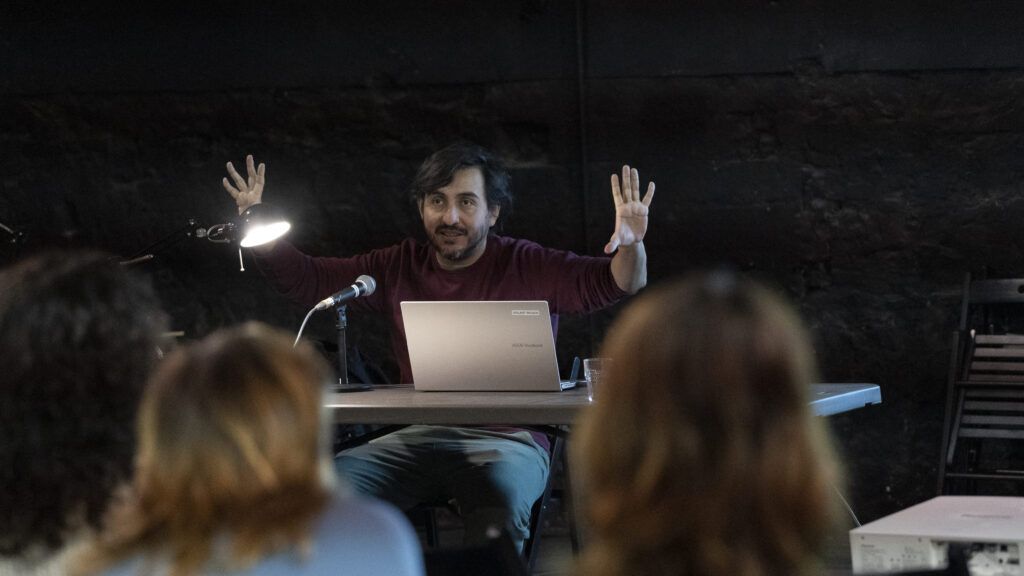
The second day recovered and delved into steganography and hacking as critical tools for intervening in contemporary digital infrastructures. Based on the idea that computers translate the world into systems of representation that are not neutral, the artist presented software to hide messages within text and proposed to imagine ways to parasitize external distribution channels. Through collective exercises, participants were able to explore possible spaces of infiltration (commercial platforms, social networks or mass events), reflecting on virality, noise, the monetization of attention and the conversion of violence into spectacle. The session concluded by vindicating art as a practice capable of generating meaning and critically intervening in contemporary forms of visibility, control and resistance.
Closing public session
December 13
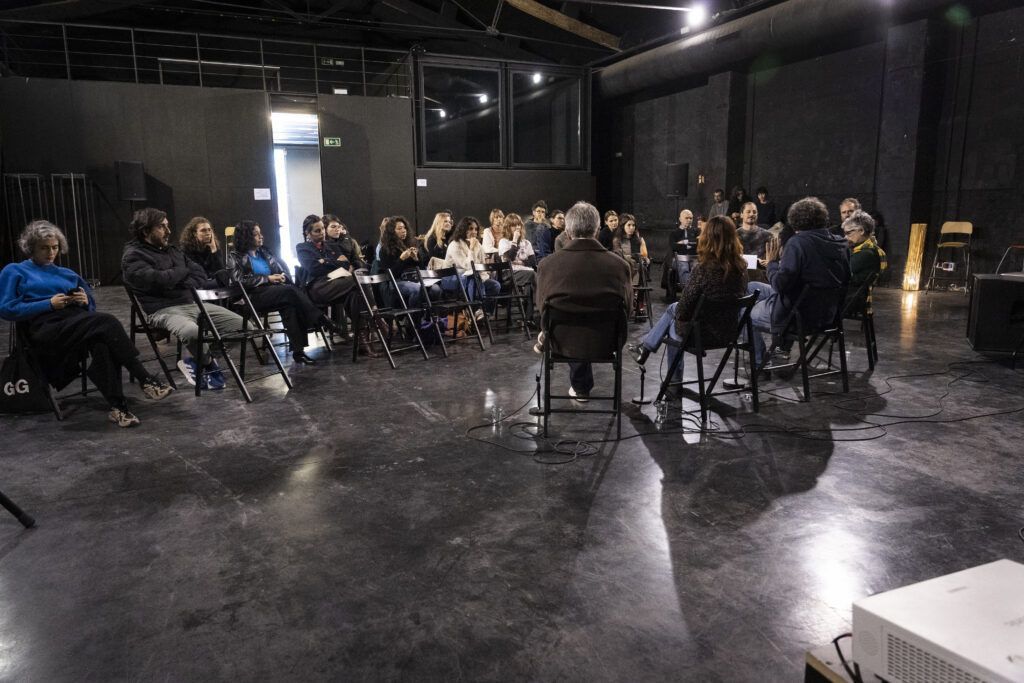
The closing session, open to the public, expanded the debate on the intersections between art, science and technology based on the contents developed during the workshops of Agustina Woodgate and Antonio Vega Macotela. Both artists shared methodologies based on error, failure and intervention in existing systems as strategies to reveal their cracks and question contemporary forms of control. In this context, the concept of “infrastructural intimacy” was also introduced, understood as the need to collaborate with professionals and institutions to access the internal mechanisms that sustain technical and social infrastructures.
The day continued with a round table moderated by Tere Badia, director of HacTe, with the participation of Elisabetta Broglio (Institute of Marine Sciences, ICM-CSIC), Fernando Cucchietti (Barcelona Supercomputing Center, BSC-CNS) and Sebastian Grinschpun (Institute of High Energy Physics, IFAE). The debate addressed the possibilities and limits of collaborations between art and science, focusing on the vulnerability of techno-scientific systems, the role of failure in research processes and the difficulties arising from economic, bureaucratic and semantic constraints. At the same time, the importance of mediation, shared rigour and collaborative work processes as tools to overcome the historical divisions between the two disciplines were vindicated.
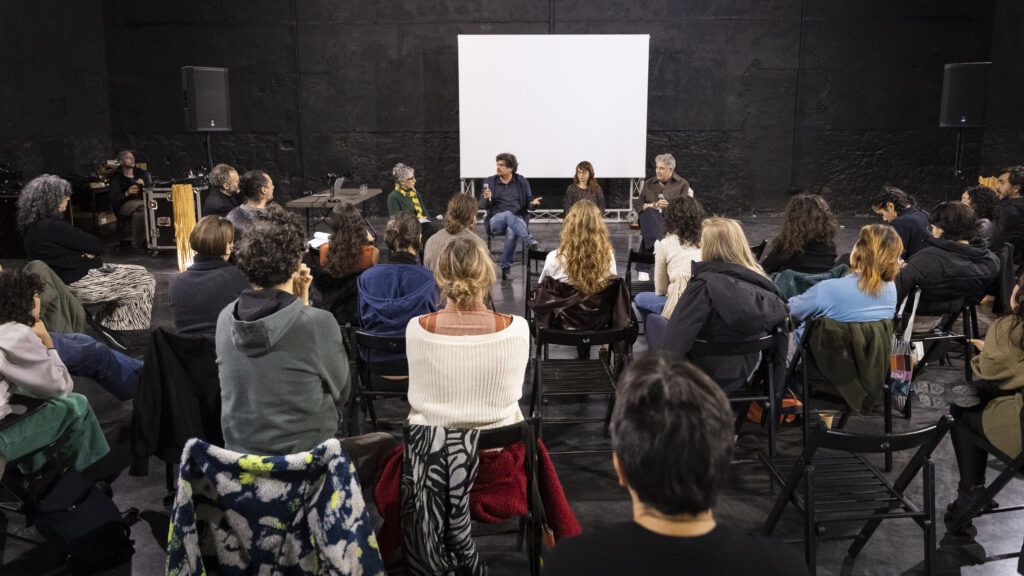
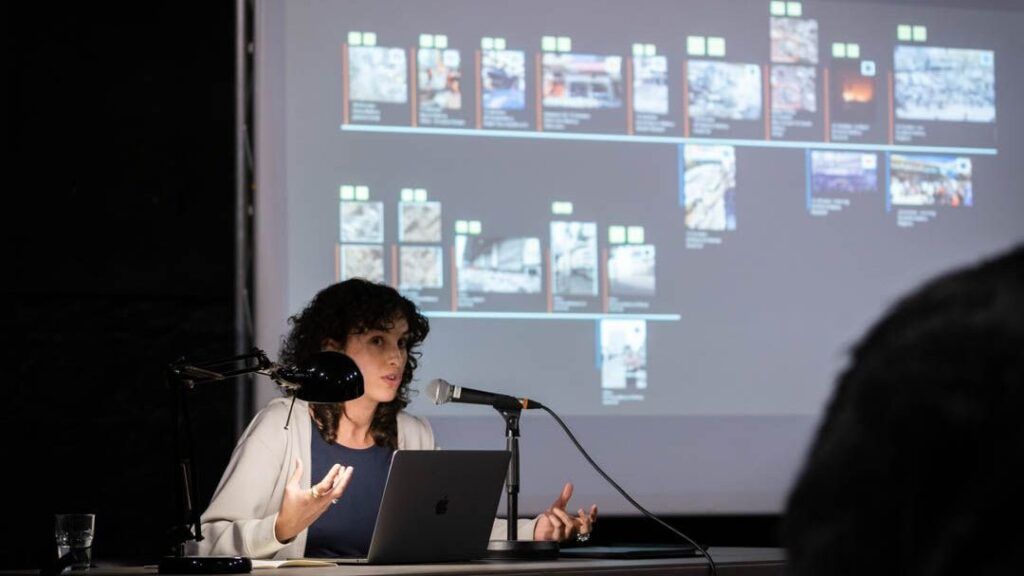
The day closed with a conference by Júlia Nueno, researcher at Forensic Architecture, who provided a political and forensic perspective on the contemporary uses of computational technologies. Based on this organization’s research on the genocide in Gaza, Nueno showed how spatial analysis, mapping and data verification can become tools to document structural violence and investigate the use of artificial intelligence in contexts of war and armed conflict. His speech highlighted the need for ethical responsibility and methodological rigour to make visible the systems of power that underpin these technologies.
Conceptualization, curatorship and coordination: Manuel Cirauqui (einaidea), Antonio Gagliano (Hangar) and tere badia (HacTe).
Production assistant: Verónica Lahitte
Rapporteur: Mar Gené
Technician: Albert Tarrats