

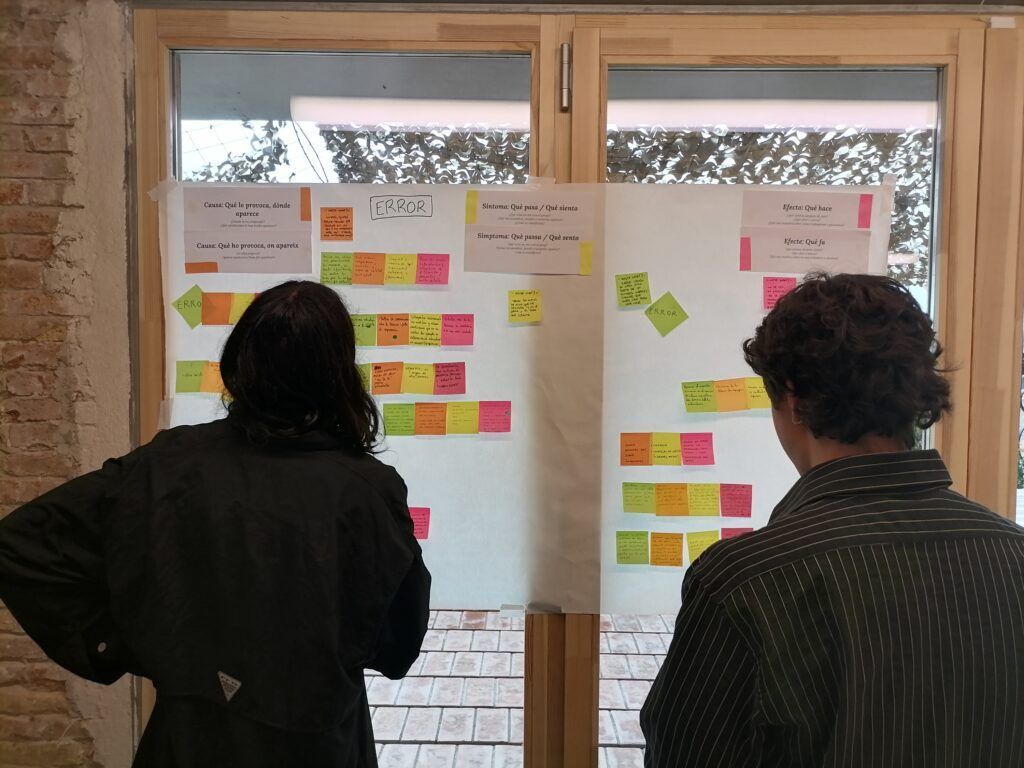
On 9 October 2025, the first opening of the AION experimental research programme was held: Collaborative Cabinet of Uncertainties and Errors. This Cabinet has been developed as a learning space to collectively navigate the territories of these two concepts through their mapping, classification, and observation. Based on the research experience of the participants, the workshop delved into the cracks that open up for collaboration between disciplines, languages and sensibilities, based on a common intuition: that error and uncertainty are not anomalies, but constitutive conditions of research on the border between art and science.
Through personal stories, collective exercises and performative materializations, the group of 15 participants have explored the role of uncertainty and error as epistemic, affective and ethical drivers in the processes of production and generation of knowledge. During the exchange, uncertainty was treated as a territory and tool that accompanies research processes and that, despite generating fear or paralysis, also promotes exploration and intuition. The challenge that emerges is how to sustain it collectively, transforming it into a form of attention to the unknown. Error, on the other hand, was described as a compass and turning point, as a learning, but also a drift. Technical or conceptual, it was described as a situated interpretation that forces the revision of expectations and norms, as well as a methodological condition of hybrid research.
The workshop underlined the affective and collective dimension of error and uncertainty: trust, accompaniment and care infrastructures are essential so that they do not become a barren terrain. The proposed materializations portrayed flexibility, surprise or vulnerability, and commas can be converted into knowledge methodologies.
Among the shared strategies are the need to observe and name errors, document processes with their affects, iterate in a reversible way and create safe thresholds for experimentation, concluding that thinking from error and uncertainty does not weaken knowledge: it humanizes it, expands it and makes it more aware of limits.
The following have participated in this session: Markus Teller, Pedro Torres, Lara Campos, Margherita Gallano, Tomás Criado, Laura Hernández, Joan Mayans, Paula Bruna, Isaac Marrero, Ximo Berenguer, tere badia, Andreu Belsunces, Anna Pinotti.
