

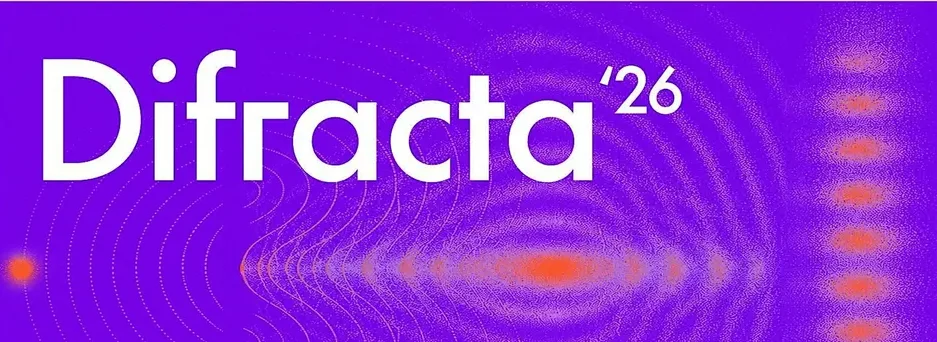
Eina Obra, in collaboration with HacTe and ICFO, presents DIFRACTA ’26, a new international festival of research and creation that will take place on 20 and 21 November at Eina Bosc (Barcelona). The project was born with the aim of opening a meeting space between art, design, philosophy and science to explore how the conceptual displacements associated with the quantum paradigm are transforming contemporary practices of research, creation and thought.
More than a festival on quantum physics, DIFRACTA explores how certain ideas arising from this field – such as relationality, intertwining, indeterminacy or the participation of the observer – are transforming contemporary research and creation practices, and how these notions are reinterpreted, translated and incorporated in fields as diverse as art, design, humanities or digital culture.
The festival is based on the observation that many of the conceptual frameworks inherited from modernity, based on the separation between subject and object, nature and culture or observer and phenomenon, are insufficient to address the complexity of current social, ecological and technological challenges. In this context, the quantum paradigm appears as a source of inspiration for imagining new ways of understanding the relationships between knowledge, matter, technology and society.
A transdisciplinary program
DIFRACTA ’26 will feature five leading international framework presentations from the fields of physics, philosophy, digital culture and artistic and curatorial practices: Maciej Lewenstein (ICFO), Vlatko Vedral (University of Oxford), Evelien Geerts (University College Cork), Femke Snelting (The Institute for Technology in the Public Interest) and Mónica Bello (Platform DALI). Her interventions will address issues related to the epistemological, ontological, methodological and ethical dimensions associated with the quantum paradigm and will serve as a starting point for a broad program of laboratories, conversations and experimental processes.
The festival will also include sixteen research and creation laboratories led by internationally renowned individuals and groups linked to art, design, research, philosophy, digital culture and science. Among the participants will be Pep Vidal, Anja Groten, Peter Teunissen representing Forensic Architecture, Claudia Claremí, Abelardo Gil-Fournier, Sonia Contera, Josep Perelló, Antonio Gagliano, Astrid Schrader, Ellen G. Richardson, Blanca Pujals, José Luis de Vicente, Jara Rocha, Lucía C. Pino, Lara García Díaz and María García Ruiz, as well as the Laboratory of Ludic Thinking, made up of Antonio R. Montesinos and Susana Rodilla. These spaces will allow students to delve into methodologies, tools and practices that explore new ways of researching, creating and producing knowledge from a transdisciplinary perspective.
The program will be completed with several artistic and performative activations by Dr. Masharu (The Museum of Edible Earth), Reiko Yamada and Lúa Coderch, who will expand the contents of the festival beyond the conventional formats of conference or academic congress.
DIFRACTA is a particularly important moment for Barcelona, a city that in recent years has established itself as one of the main European ecosystems for meeting art, science, technology and contemporary thought. In this context, the initiative is also part of the Quantum Valley, a strategy aimed at positioning Catalonia as a benchmark scientific and technological hub in Europe in the field of quantum technologies.