

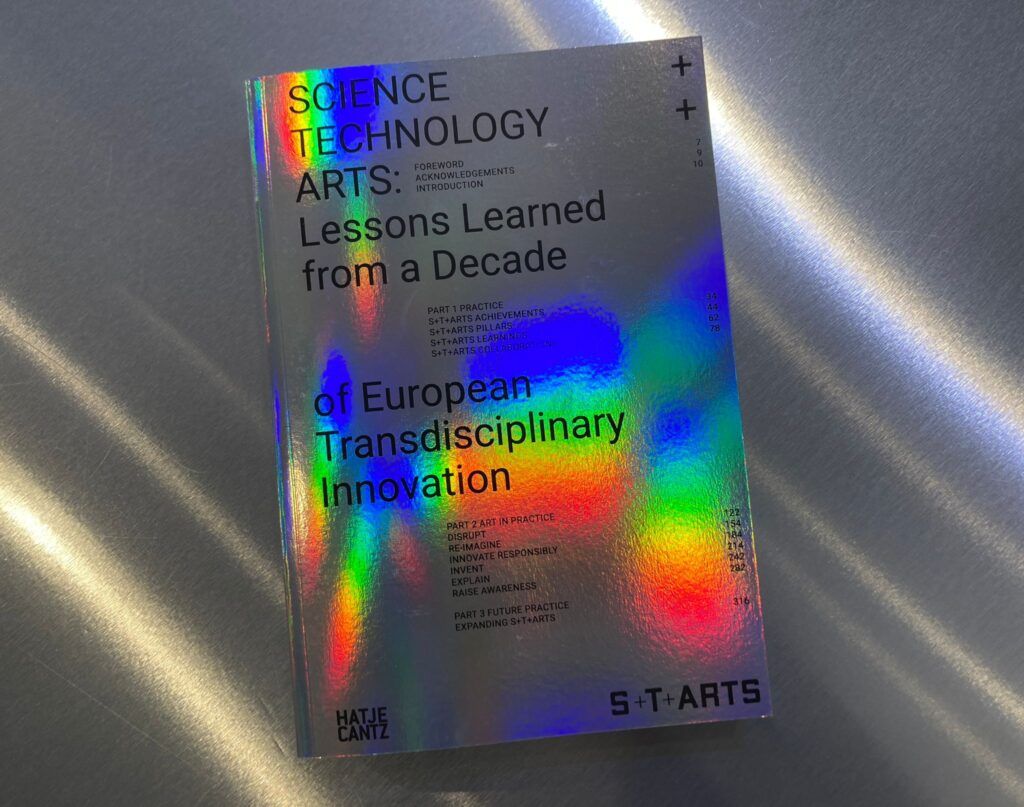
The European initiative S+T+ARTS has published the book SCIENCE + TECHNOLOGY + ARTS: Lessons Learned from a Decade of European Transdisciplinary Innovation, an exhaustive review of a decade promoting the art, science and technology ecosystem. As highlighted by Krisztina Stump, Head of Unit of DG CONNECT at the European Commission, this publication highlights “building a diverse community that develops skills, fosters literacy and accelerates the uptake of innovation, transforming prototypes into pilots and pilots into shared European capabilities”.
Through the voices of several key players in the S+T+ARTS ecosystem, the publication documents milestones and lessons learned that serve as a guide for policymakers, cultural, educational and innovation agents interested in replicating and scaling this model around the world. In addition, the volume includes a selection of projects that show how artistic and creative research and practice, integrated into the innovation ecosystem, expands thought structures, the generation of knowledge and generates impact in multiple sectors.
HacTe has participated in this publication through two articles. The first, S+T+ARTS Regional Centers: Territories of Inspiration, takes an approach to these driving spaces and projects and their role in generating contexts for transdisciplinarity that work to systematically integrate artistic practice and research into broader frameworks linked to science, technological development and society within regional innovation and knowledge ecosystems. The text underlines the importance of models such as the Regional S+T+ARTS Centres (CSR) as examples of initiatives with multifaceted value, the capacity to build solid transdisciplinary and cross-sectoral communities, cohesive territories and sustain infrastructures and resources. The article identifies challenges with the need to ensure sustained and interdepartmental political engagement, and the reconfiguration of governance models, in order to promote the rooting of these liminal spaces for transdisciplinary research and practice in local contexts.
The second article, entitled Toward a Multidimensional Framework for Evaluating Art-Science-Technology Collaborations, co-authored with T6 Ecosystems, addresses one of the major challenges of ACTS practices: how to assess the impact of projects where art, science and technology intertwine. Traditional quantitative metrics often do not capture the real impact of these collaborations, which tend to generate long-term cultural and social changes. In the article, HacTe contributes from its experience in the evaluation of the STARTS in the City residency program, where we designed and implemented an analytical evaluation model, and detected areas for improvement, tensions and good practices to develop recommendations for the future. One of the main conclusions of this work was the need to move towards the configuration of Key Transformation Indicators (KTIs) that, unlike classic performance indicators (KPIs), focus on evaluating the transformative impact of collaboration dynamics, such as lived experience, legacy or their impact on institutions, communities and ecosystems, among others. The publication also includes the text “We should say Abya Yala”: Finding a Common Ground, edited by TBA21 and written by multiple hands by members of the Buen-TEK project, the first consortium between entities in South America and Europe, of which HacTe is part (during the period 2025-2026). The text is a collective exercise carried out during the initial stage of the project that seeks to lay the foundations for an ethical and reciprocal collaboration between continents, contexts and worldviews through a critical, decentralized and decolonial look at dominant narratives.