


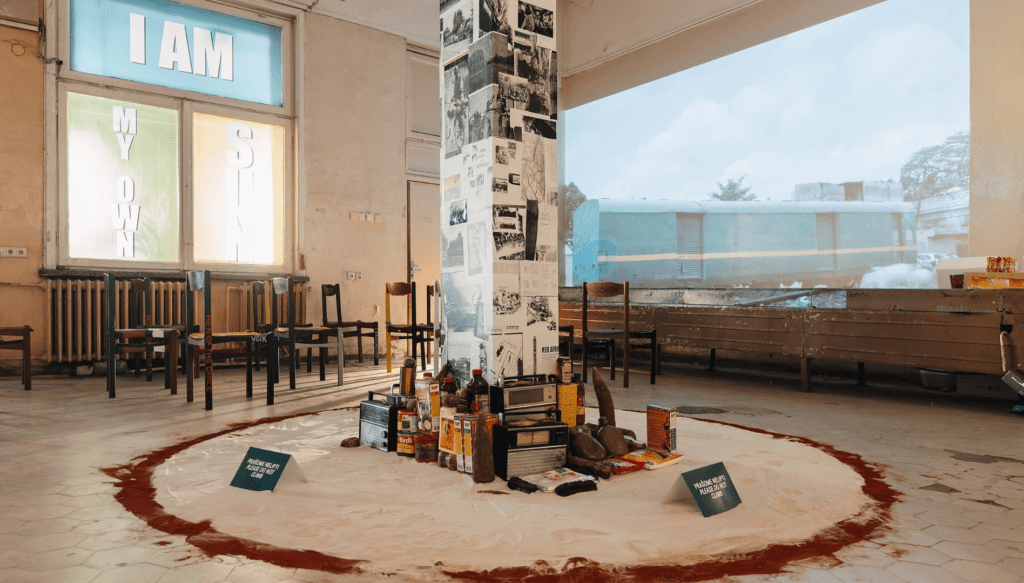
The Tecnosis program—sponsored by HacTe, einaidea, and Hangar— has opened the call for submissions for its third edition, which will take place this coming December. Conceived as a space for reflection on technoscience and its biopolitical ramifications, Tecnosis presents itself as an alternative to traditional academic modes of learning. Its purpose is to examine recent intersections between art, science, and technology not as mere analogies, but as signs of shared somatizations and vulnerabilities. Structured around two three-day hands-on workshops and a public session with guest speakers, the 2026 program will create intensive learning experiences with Hamedine Kane, Valérie Osouf, and Nerea Calvillo, in collaboration with the Barcelona Supercomputing Center.
Building on their work with The School of Mutants, artists Hamedine Kane and Valérie Osouf will launch a body of research on colonial systems of classification, representation, and knowledge, extending to contemporary algorithm production chains and their effects on bodies, as well as the distribution and exploitation of resources in Africa. For her part, architect and researcher Nerea Calvillo will open a space for collective creation to explore the material relationship between dust and technical objects, ranging from its domestic dimension to the computational infrastructures that generate weather prediction models. We will explore, both physically and conceptually, different ways of understanding dust: as matter, cross-border movement, pollution, invasion, archive, method… paying attention to how it overflows bodies, technologies, metaphors, classifications, care, and agencies.
The Tecnosis call for proposals is aimed at artists and researchers who wish to address both applied research processes and their social implications, exploring the potentials and vulnerabilities of science itself—understood here as a body of knowledge that cannot be considered in isolation or protected from biopolitical realities.
General Information
- General Dates: December 9–16, 2026
Venues: Eina / Hangar / Barcelona Supercomputing Center
Main Schedule: 3:30 p.m. to 7:30 p.m. - Workshop with Hamedine Kane and Valérie Osouf: December 9, 10, and 11, 2026
Schedule: 3:30 p.m. to 7:30 p.m.
Working language: English - Public session with Hamedine Kane, Valérie Osouf, Nerea Calvillo, and guests from the BSC:
December 12, 2026
Hangar - Workshop with Nerea Calvillo: December 14, 15, and 16, 2026
Time: 3:30 p.m. to 7:30 p.m.
Language of instruction: Spanish
Biographies
Hamedine Kane He is a Senegalese-Mauritanian artist and filmmaker based in Dakar and Brussels. Originally trained as a librarian, his work spans film, installation, photography, drawing, and printmaking. His practice draws on African and Afro-diasporic literature, political thought, and the unfinished stories of decolonization. Through archives, field research, and encounters, he examines the political aspirations and contradictions of post-independence Africa. His feature film The Blue House (2020) received a Special Mention from the Jury at IDFA and several international awards, and his work has been presented at venues such as Documenta 14, the Taipei Biennial, MOMENTA, and the 36th São Paulo Biennial (2025). A fellow at the Villa Médici in Rome (2023–24), he co-founded The School of Mutants together with Stéphane Verlet-Botteroo in Dakar in 2018, a traveling art and research platform that explores the unfulfilled promises of African independence, alternative pedagogies, and the politics of knowledge production.
For its part,
Valérie Osouf She is a French filmmaker, visual artist, and curator based in Paris, whose practice has been shaped by the many years she spent in Senegal. Working in the fields of documentary film, moving images, and installation art, she explores colonial history, political violence, and the construction of dominant narratives. Her films include Cameroon: An Autopsy of Independence (2008), National Identity (2012), Sissako, Beyond Territories (2017) and Because the Night (2027). Together with filmmaker Dyana Gaye, she co-curated Tigritudes, an anthology of 128 African and Afro-diasporic films presented internationally at institutions such as the Tate Modern and the BFI Southbank in London. As a member of The School of Mutants Since 2020, she has been developing collaborative projects that combine historical research, film, and contemporary art.
Through their collaborative work with The School of Mutants, Hamedine Kane and Valérie Osouf have participated in the 12th Berlin Biennale (2022), the Kaunas Biennale (2023), and projects in Dakar, Glasgow, Rotterdam, and Vassivière, and a group residency in La Becque, Switzerland (2024). Their collaborative practice also includes *A New Region of the World* (Kaunas, 2023) and *Where the Seams Hold Against the Fixed Narrative*, presented at Bonniers Konsthall in Stockholm (fall 2026), as well as a new exhibition at the 16th Dakar Biennale (November 2026).
Nerea Calvillo is a Spanish architect, professor, and researcher. She holds a Ph.D. in Architecture from ETSAM (Polytechnic University of Madrid) and currently serves as a professor at the Center for Interdisciplinary Methodologies at the University of Warwick (United Kingdom). She is the director and founder of the spatial design studio C+ arquitectas (established in 2004), as well as In the Air (launched in 2008), a pioneering collaborative project focused on detecting, visualizing, and raising awareness about air pollution. Her work operates at the intersection of spatial design, feminist technoscience, environmental studies, and queer theory.. His current research focuses on exploring the politics of toxicity, the natures of artificial intelligence, atmospheres, and urban political ecologies queer. In line with this theoretical approach, she is the author of the book Aeropolis: Queering Airs in Toxic, Polluted Worlds, published by Columbia University Press in 2023. Throughout his career, his projects have gained significant international recognition, being exhibited at prestigious events and institutions such as the Venice Architecture Biennale, the Royal Academy of Arts in London, the Canadian Centre for Architecture (CCA), and the Shanghai Biennale. Furthermore, his essays and research have been widely published in academic and interdisciplinary journals, such as Social Studies of Science, Journal of Extreme Events and Public Culture, among others.


