


Alba G. Corral and Jorge Marzo lead the first conversation of the second cycle of the Revers program, a space promoted by HacTe to foster dialogue about the tensions and opportunities of contemporary digital culture. In this edition, and under the title “Pixel Policies,” the debates propose exploring the technical, material, and political dimensions involved in the creation of the digital image.
Alba G. Corral is a visual artist, code developer, and teacher. With a background in computer engineering, over the past decade she has created generative art with software and code. Her practice extends through live performance, video, digital media, and installation, exploring abstract narratives and expressing sensitivity to color. By combining generative systems with improvised drawing techniques, her digital language becomes organic, creating fascinating digital landscapes.
Jorge Marzo is an art historian, PhD in Cultural Studies, curator, writer, audiovisual producer, and professor at BAU University Center of Arts and Design of Barcelona. With strong influences from iconology and image sciences, his research generally focuses on the analysis of images and artistic production as linguistic systems linked to representational regimes. He is currently part of the curatorial team of the 5th City and Science Biennial of Barcelona.
In this conversation, Corral and Marzo take the pixel as a starting point to explore the nature of the digital image and the technological architectures that make it possible. From the first digitized images to artificial intelligence, algorithmic surveillance, and visual recognition systems, they reflect on how the pixel has transformed the way we represent, interpret, and reproduce the world. The dialogue highlights the contradictions of a technology often associated with immateriality, but which depends on a physical, industrial, and energy infrastructure. It also explores the creative possibilities opened by the pixel when freed from the faithful representation of reality, as well as the tensions that its reproductive capacity poses to traditional notions of authorship, originality, and the value of the artistic work.
Alba G. Corral: Where do we start? What is a pixel? The pixel is the smallest unit we can have in a digital image. If you get very close to a screen, there is a “little square” and that is the pixel. But, of course, it has many layers, because it is not the color, it is not the screen, and it is not the “little square.” In reality, it is a number.
Jorge Marzo: It’s almost magic, isn’t it? It’s a graphic unit of screen resolution, but the most interesting thing is that it has neither mass nor matter, but at the same time it’s not immaterial, because it needs an architecture. Since the appearance of the pixel in 1965, a metaphor has been created that equates it to what the atom would be in the world of matter or to the sign in the world of linguistics. And this kind of abstract concept is linked to a scale problem: for higher resolution, we need more pixels. I think it’s a perfect metaphor for this accelerationism of capitalism: it is always forced to be more, to build more.
Corral: But I don’t think it’s something abstract, maybe because I come from engineering. The pixel was a technical decision made to represent how the machine can recognize or understand an image.

March: This recalls those distinctions made by W. J. T. Mitchell, which we don’t have in Catalan or Spanish. English speakers are lucky to be able to distinguish between “image” and “picture”: “image” is that image that has not yet materialized, and “picture” is when we talk about a photograph, a sculpture, an engraving, a painting, a screen… The pixel lives on this border. I think it’s especially interesting to see what the pixel does, which has progressed to become a phenomenal digital culture that governs our communication. And it has done so above all through an architecture of capturing and interpreting the world via sensors and cameras, an optical architecture that is everywhere and that, therefore, is a real materiality. And not only that, if we think about landfills, the pixel has produced one of the largest debris industries known. Therefore, I think it is important to keep in mind that this apparent immateriality of the pixel very often serves to camouflage or make invisible all this engineering and architecture.
Corral: You say the pixel is the interpretation of the world, right? Of a perhaps more figurative world… But I think that, at least for my practice, for me the pixel was key not to interpret the world or not to reproduce the world as it is, but to be able to express the world, internal or external, in another way. That is, I believe it is bidirectional and the pixel, which can serve to express the world, also serves to interpret it, to modify it, to monitor it, and to make decisions. Surveillance cameras, pixelated images, AI algorithmic decisions… All of this is part of an interpretation of the world and a very biased one… In fact, the first image had 126 pixels, so what representation could I make if it wasn’t biased?
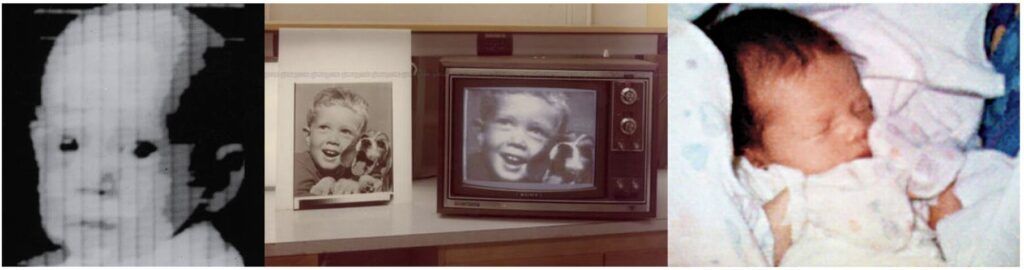
March: I remember reading that James Joyce called his mother on the phone for the first time and was absolutely stunned because, once he heard his mother’s voice, when he hung up he said: “She’s already dead.” Derrida explained this very well: the media turn people into specters. When I think of the first laminated image, I feel a bit the same. Technically, this baby is the first electronic spectrum in human history, it’s the first pixel. But there’s something even more interesting. Look at the three images: the first, this baby, is by Russell Kirsch, from 1957; the second, by Steve Sasson, from 1975, is himself when he was a child; and the third, made with the first camera built into a mobile phone, is from 1997 and is the daughter of Philippe Kahn. We can ask ourselves why the first three digital images are of very young children. The pixel paves the way for biographization, the idea begins to be built that reality is no longer important in itself, but reality is related to the person who is looking.
Corral: Another anecdote is the first image used to create the JPG, which remained a test standard: a girl on the cover of Playboy. That’s how they began to interpret the world. And this helps us understand what happened next with facial recognition systems: Western white people are more recognizable in these systems because this interpretation, representation, or copy of the world is very biased.
Also, we start from the premise that in creating the pixel the decision was to make it square. The grid is divided into units, and the smallest unit is color. It was a logical answer, although not necessarily the best. Because, what about the square? In nature, other shapes are used. How could we represent it? With triangles, maybe, or with hexagons. This happens a lot in computing: standards are adopted that last a long time, but they are not the best. What happens when you want to represent circles? The circle cannot be represented in a square without jagged edges appearing, like small saws. This is one of the great efforts when making digital images. We have to create an optical illusion so that this is not noticeable.
March: Neurologists study boys and girls who have congenital cataracts and cannot be operated on immediately. After the operation, these children regain sight and it is possible to investigate how their vision capacity is configured. And they have discovered that during the first four or five weeks, what the brain does is try to train neural networks to understand visuality. And how does it do it? Through bad, very pixelated, very illusory images, because simply the brain still cannot understand that it is defined. The brain deceives itself and, little by little, trains.
Corral: Yes, it’s as if the brain fills these holes.

Marzo: And it’s actually very interesting to see how the pixel is formed or even how generative images are trained through algorithms that review the dataset, because they also have to do something similar. Both machines and living beings and biotechnical beings need very poor quality images to train themselves to understand the world.
Corral: Speaking of this world of low-quality images, it’s very curious how we’ve moved from those images from the sixties, super pixelated and with few colors because the device couldn’t represent them. Back then, we tried to move forward to solve this limitation. And now, on the other hand, there’s the whole culture of glitching, GIF, and going back to working with these images. In this sense, I find Hito Steyerl’s work and the concept of what he calls “poor image” very interesting: a compressed image, copied a thousand times, that loses quality. She defends this image because she says this is our world. Also her “ironic tutorial to be invisible” where she says you have to be smaller than a pixel and that way you will be more invisible
March: For me, the extraordinary power of the pixel is its capacity for replicability. In the eighties, there was a very Platonic idea that the image was a deception, a copy. But suddenly, when the scale of the replica produced with the pixel arrives, all this is turned upside down and makes us wonder what ontology something has that has no original. I think here Steyerl makes an important contribution and does not fall into the trap of saying that the pixel democratizes the image, but makes it possible to remove the image from authoritarian control of the archive.
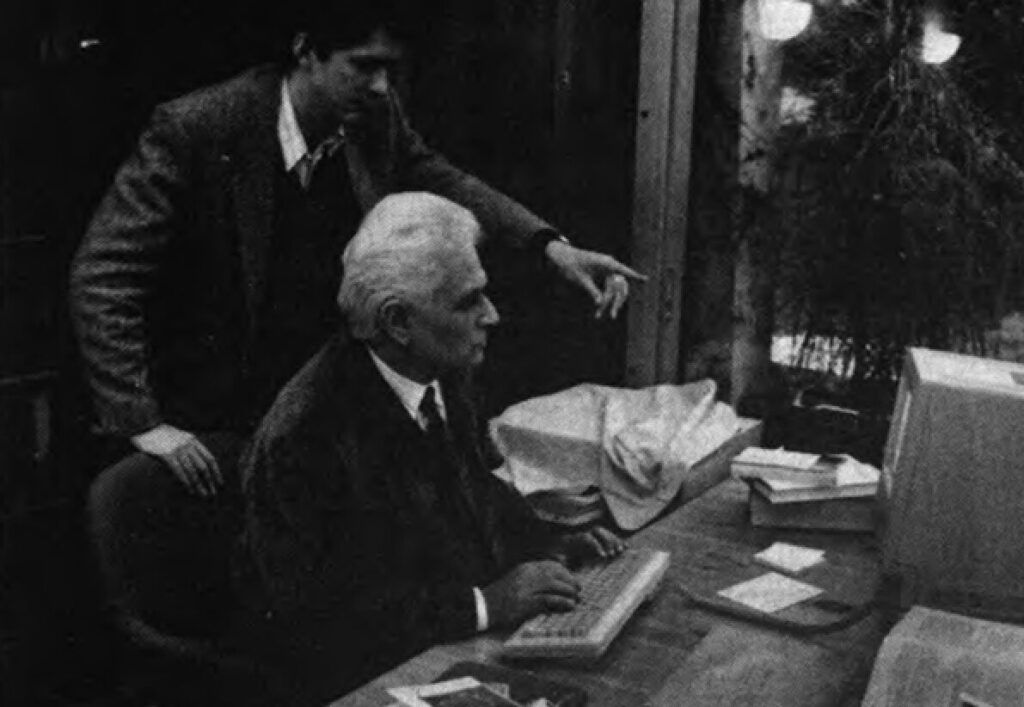
I’m also interested in Derrida’s obsession with computers, specifically the Mac. In fact, Derrida has a lot to do with how the Mac user interface was configured. When they had the whole desktop set up, with object-oriented language, then they realized the trash bin was also on the desktop. And usually trash bins are not on the table. The engineers called Derrida, the world’s most famous linguist, and consulted him, and he said, “Leave it there. It’s a metaphor and people will swallow it.” But what I want to highlight here is that Derrida said he could not have developed his deconstructive thinking without the computer, without copy-paste. This makes me think of the pixel as a ticking time bomb installed in a communication society: we have finally gotten rid of the toxic relationship between the referent and the image.
Corral: And what can we do with the pixel without there being a reference to the real world? Here comes the artistic practice of creators who, like me, use the pixel, and also in an abstract way. It’s a wonderful tool that lets you take your time and change this whole mesh, this matrix of dots to generate new ones. And you can also do it the other way around, that is, use a figurative image to extract the colors. It’s like scanning this image and seeing the matrix, all the numbers behind it. That’s it image processing And it’s amazing because, in real time, you can translate this image into pixels.
With video games, for example, this dot matrix has changed the concept of the pixel. Not so much the representation of the pixel on the device’s screen, but the way the machine interprets colors. With the GPU and drawing directly on the graphics card, everything changed: you no longer drew pixel by pixel, one after another, but sent the entire mesh and the machine calculated all the pixels at once, in parallel. The aesthetics are completely different, and so is the way images are processed. You gain in processing power and speed. And it’s fantastic because you’re not drawing in relation to the screen or what you see, but in relation to the numbers that make up the colors.
March: A fundamental thing is that the pixel is the basis of a language designed to be understood by machines. 80 or 90% of the photographs taken in the world are not designed for us to look at, but for machines to see them and draw conclusions. Thanks to the pixel, these languages are produced and we are forced to learn them. We communicate with machines thanks to this language, and we intervene in an operating system designed for them.
Corral: We’ve had to learn to read pixels, but also the devices that represent them. That is, we also have to ask why we used to have square images or why now everything is vertical. For me, it’s not so much a matter of the pixel as of the devices and machines that make it possible for us to read it. I don’t think it’s just technological decisions; there are also political decisions that have made everything go this way.
March: Nowadays, to hide something, we say it is pixelated. The word “pixelated” has ended up having a negative connotation. It’s interesting because this metaphor, which we use to talk about a hidden image, can also make us see that the pixel is a curtain: a curtain behind which everything is dark. And this curtain can be hiding devastating architectures from an ecosystem, social, and cultural point of view.
There is another thing I hate about the pixel called “Arial.” Helvetica did not correspond to the bitmap that existed then, and then Arial appeared, which is a shame. [laughing]

Corral: Yes, or Comic Sans, which already had a curve, is a kind of pixel hack, because it’s hard to represent.
Marzo: With the bad reputation Comic Sans has and maybe we have to bring it back…
Back to the conversation, I think the 19th-century mentality, based on authorship and the uniqueness of the work, has been subjected to enormous tension for the pixel. The pixel can no longer respond to these authorship architectures.
Corral: If we start from the base of an art market that seeks exclusivity, it seems that if you make many copies of a work it loses value. But I think there are other possibilities… We cannot think of buying and selling images in only one way.
March: But notice that the pixel forces us to think that the value of an image lies in its replicability. If an image has been replicated four million times, in the digital world it can have more value than an image of which there are only one or two copies. And this has a lot to do with the absence of an original.
Corral: For me, blockchain technology is very relevant because it allows you to have the freedom to make whatever contract you want and establish traceability of the pixel or the file.
Marzo: I think blockchain is a way to return to the philosophy of the 19th-century author.
Corral: It’s a way to give freedom so that you can decide, as an author or as a platform, which contracts you establish. I’m not talking about NFTs, but about giving a certificate. If you want to return to very rigid copyright, you can, but the contract I can establish through blockchain can be very different. This breaks the traditional gallery market frameworks, because the pixel travels differently.
March: When you say “traceability,” I think you place yourself in a forensic logic. There is this 19th-century logic of tracing the work to the author, reaching the idea, the real object, and the single referent. On the other hand, the pixel skips all that.
Corral: Yes, and that’s why now a tool appears that allows you to retrace it. There are many creative rights that remain locked because of this: if you can’t trace the authorship or copies of a digital artistic piece, it’s very difficult for the people we want to sell or those who buy a digital work made with pixels.
Marzo: I see it as unnatural, but I understand the artist’s logic. I think we still don’t know what authorial architecture we have today. Maybe it’s impossible to define it because the pixel doesn’t allow it. So what we do is go back to the 19th century and recover a kind of legal textuality that, deep down, is contradictory to the pixel. I perfectly understand the labor and union logic of people who produce art, but there is a contradiction.
Corral: But we’re also talking about creative commons. I’m not saying traceability should lead to completely closed rights. I’m talking about a freedom: that you can decide, that you have that possibility. And this has been closely linked to the pixel and the image.
March: I agree with that. The artists’ practice also reminds us that perhaps we have set aside questions we considered old, linked to previous structures, and now we have to rethink.
Corral: The path of the pixel is also interesting when creations move from the digital world to the material world, when we print them and turn them into paintings. RGB color management shifts to color management with inks. The device changes: the pixel no longer depends on the screen, but on another material device.
Marzo: It’s nice to think that the pixel needs to dress.
Corral: It needs an ego because it has to be represented. In the end, it’s a number, and this number, for the human eye, needs interpretation. If we say “25500,” maybe I think of Valentine’s Day because I associate it with red, but you stay the same. That’s why you have to dress it, interpret it.
This conversation is part of the Revers programme, which has the support of the Department of Culture of the Generalitat de Catalunya and aims to activate debate and generate knowledge around various aspects that affect the field of digital culture.
The series proposes duo conversations between creators, researchers, developers, managers, and other agents in our context to explore, from different perspectives, key topics that cross digital practices.
This conversation has been edited for clarity and conciseness.