

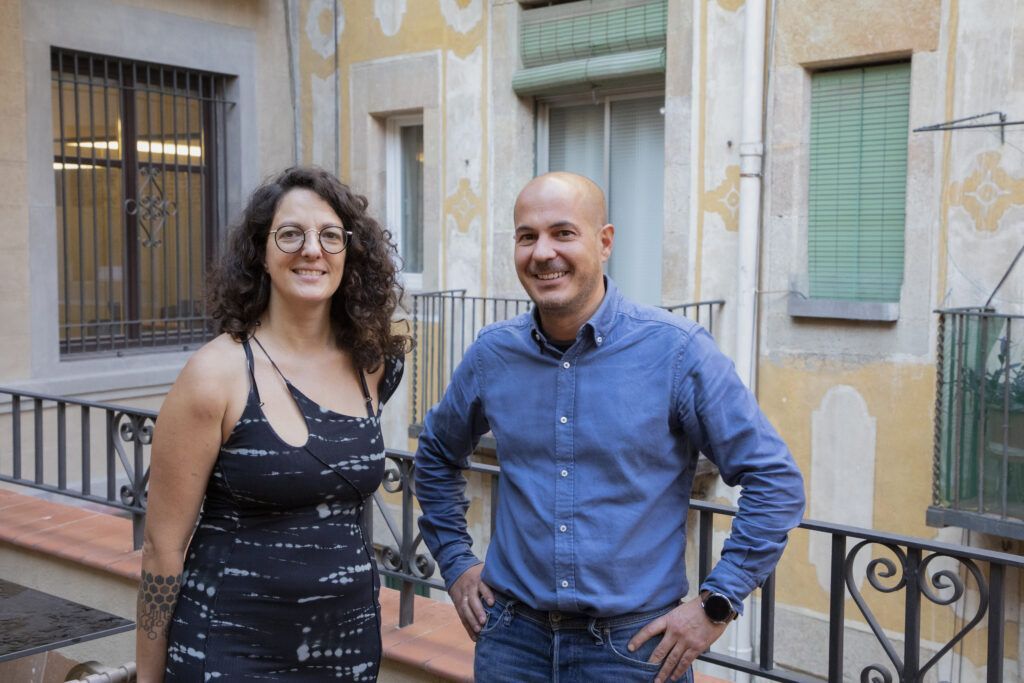
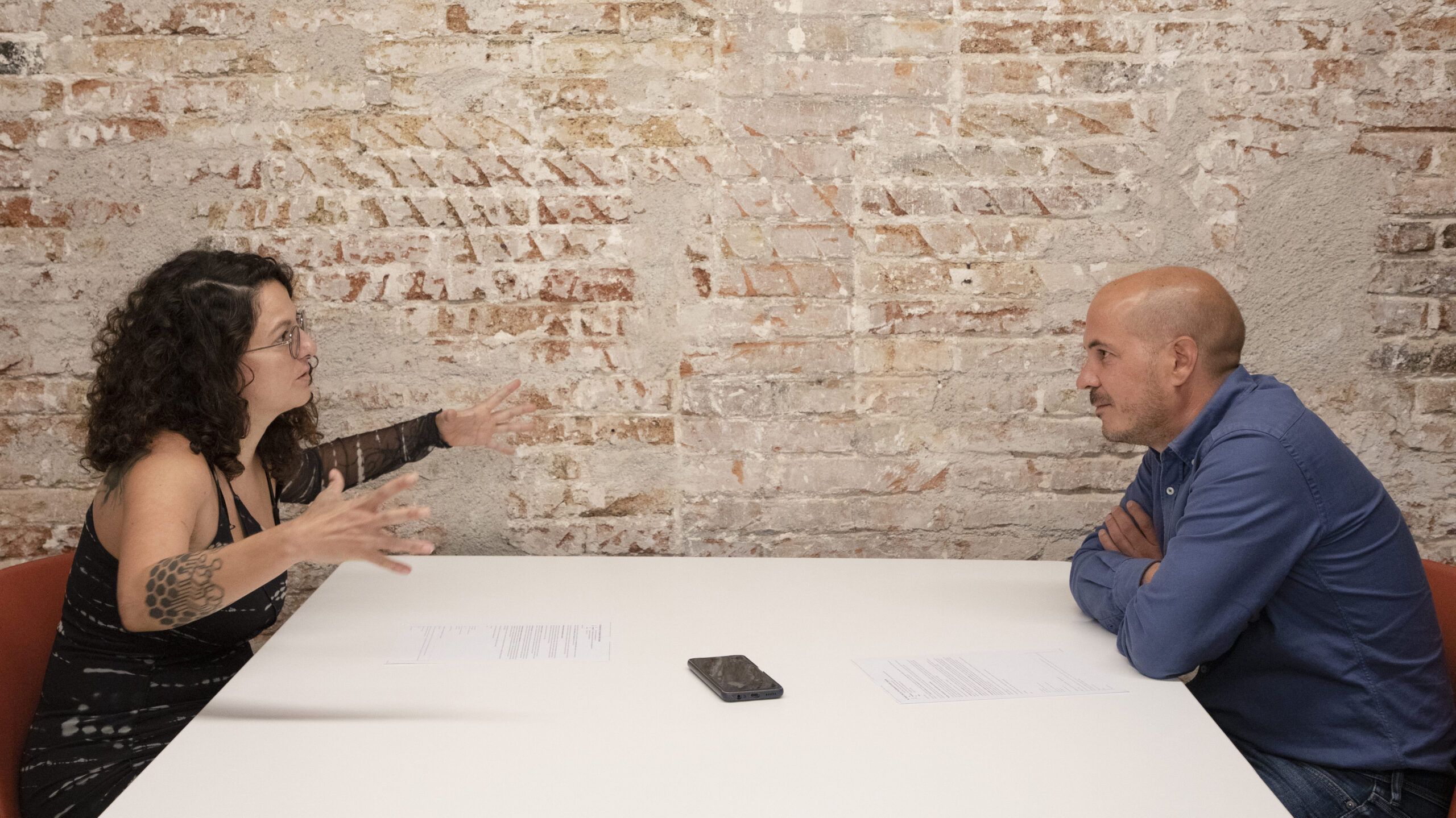
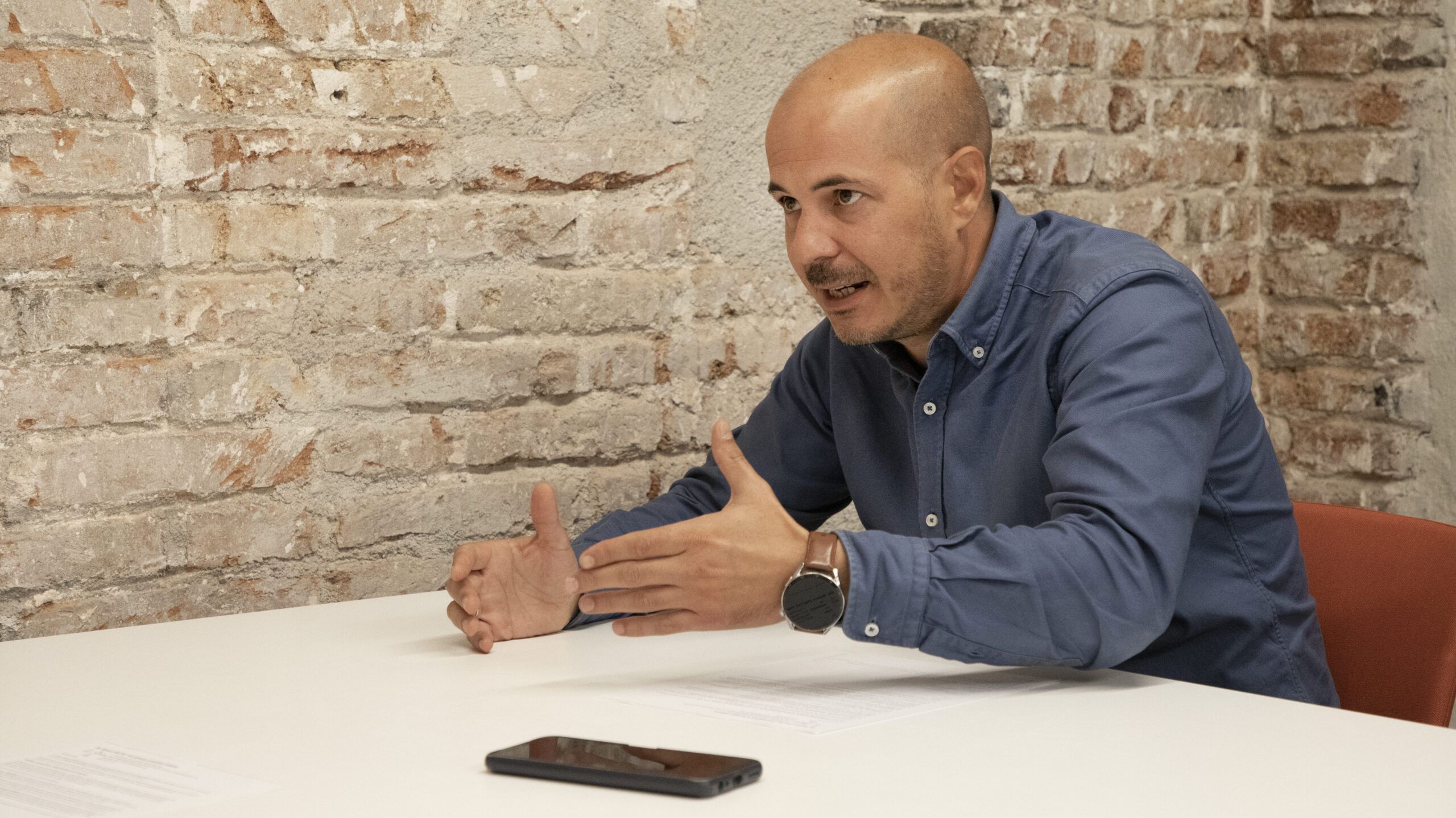
In this new conversation on the blog “Experimenting at the interface”, Eurídice Cabañes and Fran Iglesias explore how the relationships between cultural, scientific and technological practices are constructed and tensioned. The dialogue focuses on the frictions between qualitative and quantitative value, the need to make processes visible and the role of culture as an agent capable of activating the collective imagination, influencing public policies and intervening in the technological future with a critical perspective.
From a perspective that questions both digital hyperacceleration and the dynamics of capitalization that condition culture and science, Cabañes and Iglesias propose strategies to rethink infrastructures, imagine new frameworks of collaboration and claim common spaces that allow knowledge to be generated in a transformative way.
This conversation closes the Revers programme, which will hold its last session open to the public on 9 December, at 6 p.m., at the Antic Teatre.
Eurídice Cabañes is a philosopher of technology, with a doctorate from the Universidad Autónoma de Madrid. She coordinates digital social innovation initiatives, situated technologies and recreational culture with international impact. She has been the founder and director of ARSGAMES, an international research-action collective in which she has developed cultural, educational and technological projects with institutions in Europe, Latin America and Asia.
Fran Iglesias is the current Head of Innovation and Digital Transformation and General Manager of the Épica La Fura dels Baus Foundation. Its work focuses on promoting Research and Innovation (R+I), fostering horizontal collaboration between science, technology, humanities and society.
Eurídice Cabañes: Starting with the classic “medium is the message”, I think we live in a world where content is very much determined by form. The speed of social networks, short reels and those mechanisms of chronological phagocytosis that capture our time, mean that speeches and debates have to be very fast. Perhaps the first way to reverse the hoarding of economic, symbolic and social capital is to start thinking about other formats, structures and logics of cultural management infrastructures. And start thinking more slowly…
Fran Iglesias: I think there are two ways to make these changes. One is the radical way: reinventing everything. And the other is a concept that I like, that of the Trojan horse. That is, to understand what the system is like, how we enter it and, from within, to make the necessary levers for change. Here, the culture and arts sector has often been relegated, it has been a way of getting us out of certain debates.
When we talk about capital, one of the things we have not been able to do is to pay the necessary attention to all the capital we generate. We tend to focus on the end result. But when we talk about experimenting at the interface, the important thing is the process, the path, and everything that happens in this intermediate space, because this is where equity ceases to have so much value and it is where dialogue, debate, intersection are generated… and where the new can arise. And this interface where new value is generated is not result-oriented.
E.C.: Completely, I think it is very important to make the processes visible. Right now, for example, a lot of focus is being put on the impact of AI on copyright, and I think the fight shouldn’t be there, but precisely in the loss of the process. The risk is not so much the AI itself, but the system in which it is integrated, which seeks hyperproductivity. When you enter into logics where the important thing is only the result, you end up optimizing what is cheaper and faster and you end up losing the pleasure of the process.

F.I.: Although it is fundamental, I believe that we should not focus only on pleasure. Often the creative sector sells only this part and as you say, capital is the process, and this process has much broader impacts. I’m thinking of an example about the need we have to learn to value what we do more: we recently participated in an S+T+ARTS project in which artists presented the final results of their transdisciplinary research processes at a festival we organized in Badalona. In my opinion, the value of this project goes far beyond this festival, we must add the new lines of research that, for example, emerged from the Barcelona Supercomputing Center or Sony, the new knowledge generated from collaborations with scientists and technologists and the impact of these on the scientists who are now building the future… And this is not only visible when presenting results at a festival. We must be able to add all these elements together and value it in order to go before the institutions and defend the need for investment in these practices.
On the other hand, playing at the interface must force all parties to understand each other and look at the same parameters so that the balance of capital is honest. Otherwise, it is not a collaboration, but we become a commodity for others. The sector must believe it, it must be aware of all the value it generates and explain it without complexes.
E.C.: I have to agree with you and I have to contradict you in equal parts. Not everything has to be quantitative. We have to give more value to the qualitative and to things that are not measurable in figures. The big lie that we have swallowed with Big Data and AI is that data is information and that if there is no number, there is no information. To value the process is to value everything qualitative.
And in this I think pleasure is fundamental and must be at the center, because I believe that culture has the impressive function of transforming the world through the activation of collective desire, and for this we must detonate the imagination and be able to imagine new worlds because otherwise we are doomed to failure. But this takes time, because desire is not activated in constant production, but when you stop running to deliver the next production or subsidy justification. You have to be able to stop, breathe and activate desire, and for this reason pleasure must be at the center.
F.I.: This collective desire is for me the new narratives and imaginaries, the social transformations. I think that what needs to be quantified is the paradigm shift. We need to establish methodologies to measure the impact on another level, the impact on minds, and as you say, this takes time… There are brutal success stories about how applying culture and gamification has made entire neighborhoods safer and more livable. If an urban planner had done this, he would have sold it as a great thing, but as it was done from the cultural sector, it remains as an anecdote. We need to value all these initiatives so that they happen in more places and people understand the value of these dynamics.
E.C.: But I think that valuing can be a trap. Both for culture and for science. When you want to value it, you have to ask yourself “for whom”. Many times when you want to value culture, you end up following the same traps that science has fallen into, which is to create a kind of elite that talks to each other and understands only each other.
The flat earthers are not to blame for the flat earthers. He is one of the scientists who put aside dissemination as if it were not important. And a lot happens with art: art with capital letters, high culture. Many times, when trying to value things, what we do is distance them from the people who should be valuing them, distancing themselves from their function and connection with them.
F.I.: But this is a misinterpretation. At the ZKM Center for Art and Media they are already talking about useful art. There is an elitist art that I like the least, and there is a connected, transformational art that makes you think. When you do a performance, the best thing is the reflection after the forum, because that’s where things are generated. The quantifiable impact on transformations is where the value lies.
Historically, art has had a very important mission, such as with the puppets of Charles V, which was to prepare people to understand that the year would be complicated. In a society where science and technology play such an important role, it is very important to bring these dilemmas closer to society so that it is able to assume them, understand them or not.
E.C.: I think we need to think about strategies that not only translate complex ideas, but that let people participate and read the situation. We can do this through a situated ethnography to see where the needs are and where the desires of the people are. If you activate these things, the network you are activating will subsist beyond the grant cycle. If we put the effort into this, we will not end up carrying out projects that only respond to the needs of a subsidy.
F.I.: Exact. In projects such as an S+T+ARS, you want to generate knowledge in between. Then you have to take the focus away from the final exposition and put it to generate new paths, new visions, new ways. Here the relationship between science and technology is much closer and more horizontal.
E.C.: If we continue on the wheel where science is financed by interests for military purposes or that only seek the techno-solutionism of Silicon Valley, this will continue to generate a discourse where we believe that the situation is no longer reversible and that only the latest innovation will save us.
We need to go back to the body and other forms of perception that we have left behind, looking towards syntropic technologies and permaculture. Maybe we have to go less, not more. I don’t need the broom or kitchen to have AI. That makes us dependent. We must question science and technology: to what extent and for what?
F.I.: In Old Europe we have the opportunity to do it well. Scientists made the mistake of making Nostradamus, only explaining why we would go to ruin and not what we should do to avoid it. The cultural sector must take advantage of these gaps.
The new European Artificial Intelligence framework is an opportunity. We have to be a counterweight. If we over-legislate, we burden innovation, and if we don’t legislate, it’s a runaway horse. We must be able to enter it to make policy recommendations from experience.
E.C.: I understand that regulation can stop innovation, but it’s important to think about what kind of regulation allows innovation towards the AI we want. It’s not just about laws that prohibit, but about generating our own systems. For example, digital public infrastructure is crucial.
If we do not guarantee that our health or defense data belongs on our own site, we cannot talk about citizen rights. We need to provide digital public infrastructures (servers, cables, the most material part) in order to generate a space where things happen and we can set our own rules. If we do not start from a digital public infrastructure environment, what we build on an alien technology will already condition the forms and uses. This must be modular and modifiable, like roads. The State provides the infrastructure, but it is the citizens who create it and the civil associations intervene.
F.I.: The risk is that our capacity as citizens is irrelevant to others.
E.C.: It’s not that we don’t have the capacity, but that there is no political will because there are many lobbies against it that pour billions into it. If this money were invested in digital public infrastructure, there would be no brain drain.
F.I.: The BSC is public, you have public infrastructure (the most powerful in Europe), so what? Because it’s not defined how to use it. That’s why you need the “damn paper” that says why you can use it. If it is not well defined, in the end they will use the same data as always.
If we don’t sit at the table with this vision and say “I can help you make this framework“, it will be designed by four engineers with no social vision. The only opportunity is to be at the table to ensure that this framework respects or opens windows where we want to go.
E.C.: Yes, you have to be at the table and also on the outside side so that people put a lot of pressure. Because there are very good visions on the table, but suddenly Microsoft, Google and Amazon arrive with millions and change everything. You have to apply pressure with the same force. The same force of millions of euros is made by millions of people on the street.
F.I.: You have to transfer to people what’s going on. I refuse to think that with the cultural sector we have in Europe, we cannot explain why it would be better to have our own tools, such as a European AI.
This conversation is part of the Revers programme, which has the support of the Department of Culture of the Generalitat de Catalunya and aims to activate debate and generate knowledge around various aspects that affect the field of digital culture.
The series proposes duo conversations between creators, researchers, developers, managers and other agents in our context to explore, from different perspectives, key issues that cross digital practices.
In this third thematic block, dedicated to reflecting on the relationships between different knowledge practices and development methodologies, Eurídice Cabañes, Joan Llort, Mariona Moncunill and Fran Iglesias participate. The conversation will be opened to the public in a public debate on December 9, 2025 at 6 p.m. at the Antic Teatre.
This conversation has been edited for clarity and conciseness.
