


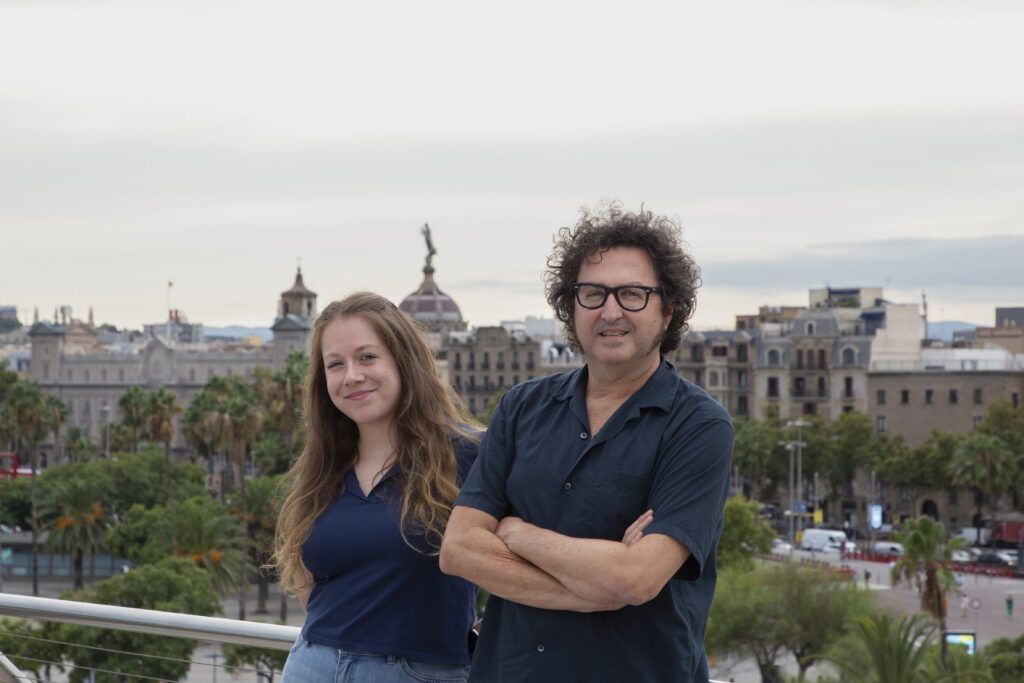
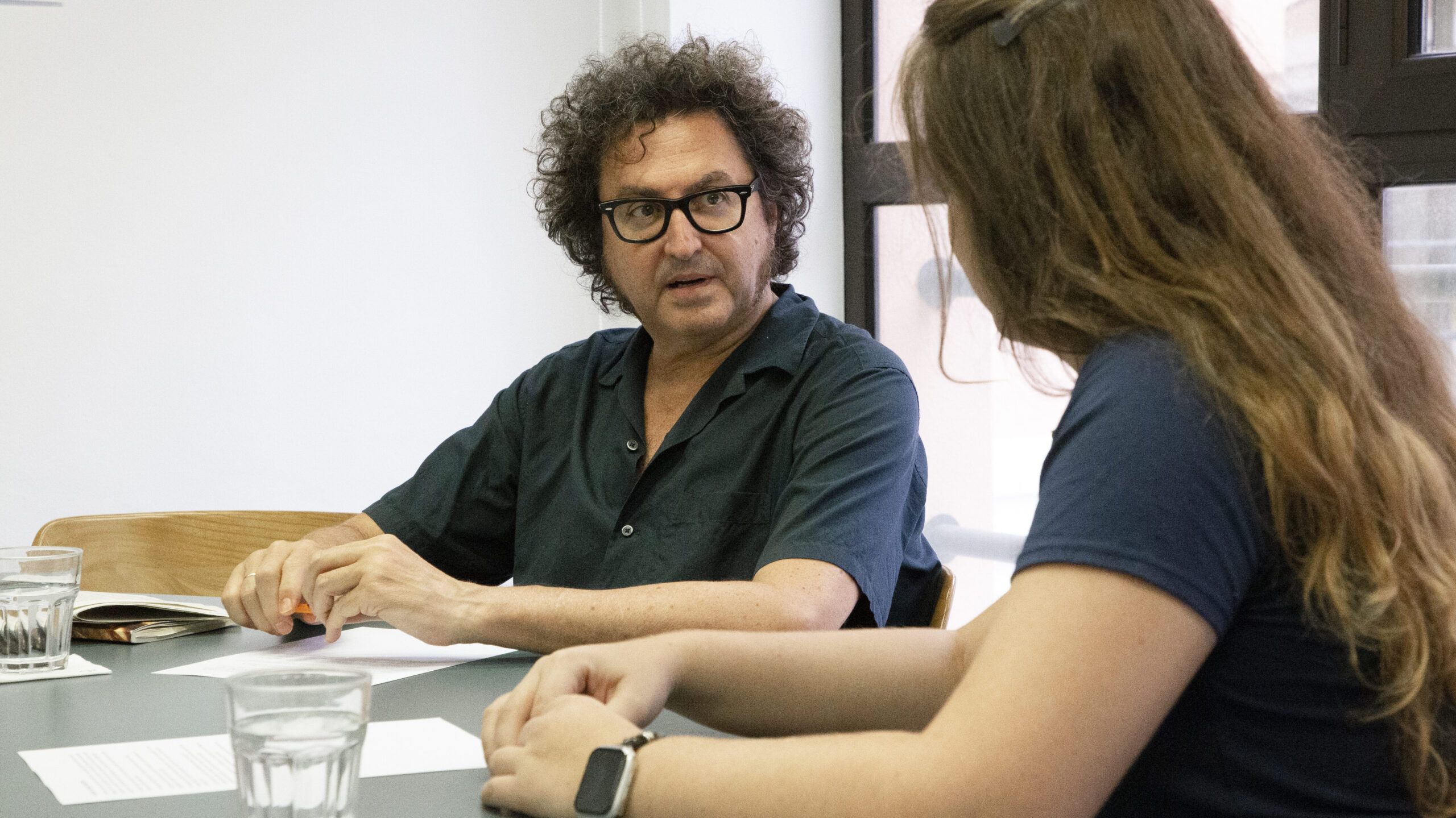
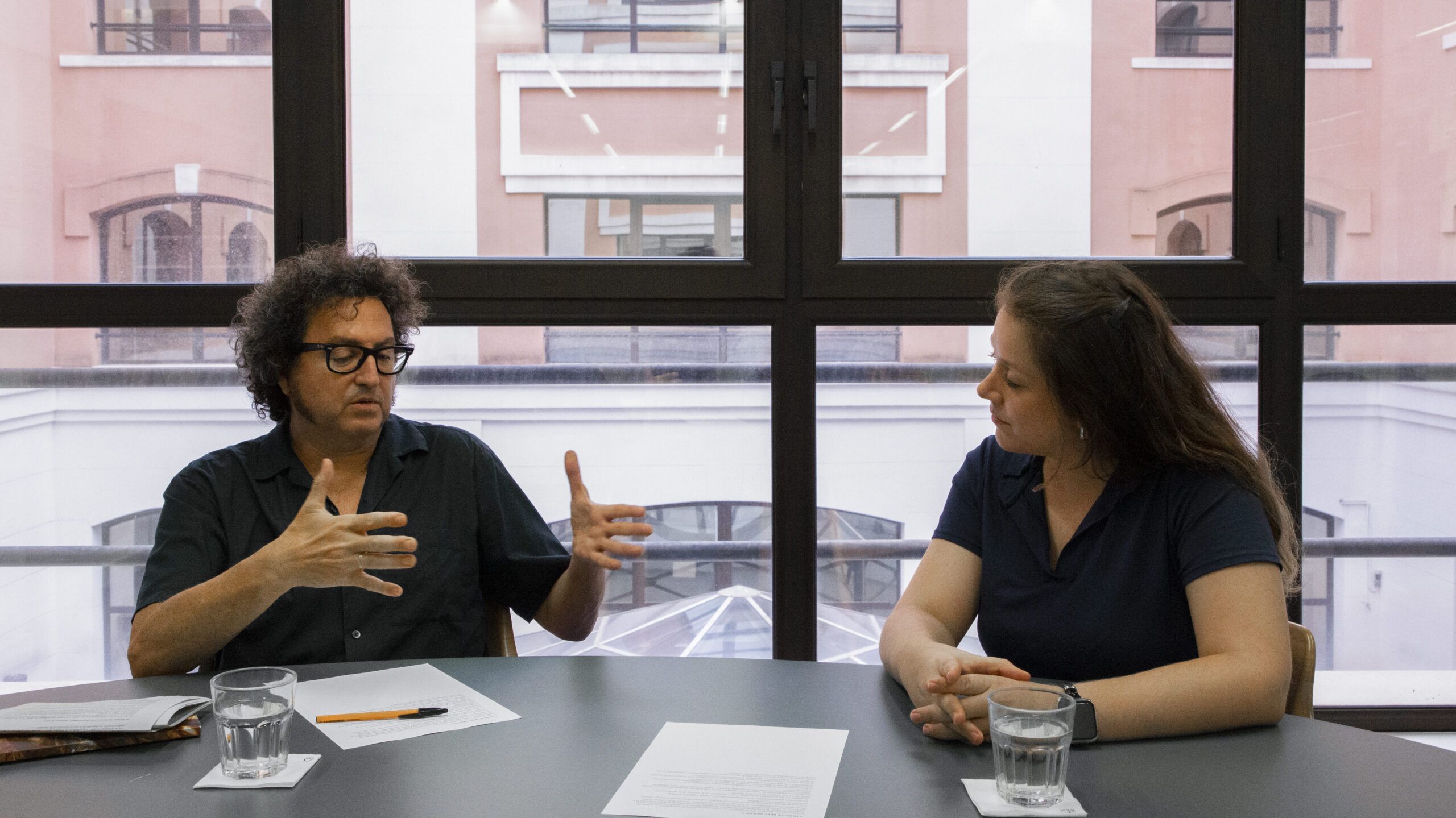
Mireia de Gracia and Daniel G. Andújar are the protagonists of the third conversation of the programme Revers, a space promoted by HacTe that promotes critical dialogue on the tensions and opportunities of contemporary digital culture.
Mireia De Gracia is a Telecommunications Engineer and DJ, with a great interest in Sound and Music Technologies. He has been part of the AIDJb2b project, a co-creation of the Polytechnic University of Catalonia (UPC) and Sónar. Specifically, his participation in this group has focused on exploring the possibilities of an AI-human interaction in the context of a live DJ session. Daniel G. Andújar is a visual artist, theorist and activist. Since the nineties, his work has been investigating the relationship between the real and the virtual, and the structures of control that emerge in the digital society. Through projects such as Technologies To The People™ or Postcapital Archive, he criticizes surveillance capitalism and defends the right to technological access as a fundamental cultural right. A long-standing member of irational.org, his work combines research, public intervention, and institutional irony to question the promises of digital democracy.
Aquest diàleg engega un nou cicle temàtic, sota el nom de L’algoritme i el capital, que se centra en el paper de la intel·ligència artificial en la creació i la recerca, i en els nous reptes que planteja per als drets culturals, l’autoria i la producció col·lectiva. De Gracia i Andújar reflexionen sobre la transformació dels processos creatius, el valor del treball artístic en un ecosistema automatitzat i la necessitat de models oberts, ètics i transparents que situïn la tecnologia al servei del bé comú.
The conversation covers topics such as job insecurity, surveillance capitalism, the return to exclusivity with NFTs, or the urgency of critical technological education capable of responding to the speed of change.
Mireia de Gracia: Recently there have been some artificial intelligences that have been able to reproduce design styles or photographic styles of some authors. And I think it’s important to ask yourself: as an artist, how would you feel if one day you woke up and saw half of the internet sharing images of your style, of which you have neither the authorship nor the idea?
Daniel G. Andújar: I believe that culture is a system of transfers and there is nothing that is original in this sense. In fact, it’s something I’ve always defended. Militant in the Creative Commonsmovements of the nineties, he was probably on the most radical side, which defended total freedom. And this implies claiming the right to appropriate.
The issue of appropriation – the collage, the sampler, the mixture of various elements… – is a question that has always been on the table. Artificial intelligence is a model that is trained in a very similar way to how artists have been trained throughout history. That is: reading books, seeing a cover, reading an author who leads you to another, appropriating, grabbing…
I don’t think what is happening at the moment is something much more radical, and the question lies in where we put the focus, in what we understand by value in cultural processes and in culture in general.
M.G.: The main problem we are facing now is that all this music or works that have been used to train AIs have licenses that have not been respected. And in many cases, the larger tech companies behind it not only can’t use this music, but hide that they do. All these models, which we call “black box”, do not give you information about the parameters and there is no transparency that allows you to reproduce the same experiment and obtain the same result. They have not respected this.
D.A.: Well, we have experienced the paradigm shift from industrial society to the information society, and now to this digital society. And we have to change the order of the values in this sense. There was a moment when we freed ourselves from what was virtuosity, from the artisanal thing of industrial society, which focused all the value of the artist, or the craftsman, on the format itself and on the device itself, which was a single device and entered into a system of capitalist values and speculation.
This is a paradox, because this supposed liberalization that has taken place with artificial intelligence and digital processes has put many more creators on the ground. In other words, there are more people who have a capacity to create that they did not have before, perhaps because they did not have these virtuous conditions. But the big question is: what will all these creators live on? And this is where I think that if we change the paradigm and bring it towards the fact that culture is a right, then we should create a culture that is cooperative, with open production systems or other alternatives, because the copy and reproduction systems that we have so far do not serve us.
M.G.: Yes, that’s what is currently happening, although artificial intelligence is not such a recent thing. In the end, algorithm and machine learning have been around for many years in academia. What happens is that now it has gone from a very limited world to a more commercial world, because it is something very attractive and you don’t need to have technical knowledge to be able to use it. I agree that we must move towards open models that are public, transparent, with the published parameters, and that anyone can use them. At Pompeu Fabra University there is a research group on music technologies, which has been a pioneer and has created a completely open database. And the artist can decide at any time what is done with that music and leave it, or not, at the disposal of the training of artificial intelligence. This is where we have to go, because this way it is very easy to audit what has been used and what has not been used, to do watermarking to prevent deep fakes…
There is also a lot of interest in seeing how far AI can go to generate, for example, music that is as similar as possible to humans. Here we have seen a very large opportunity for exploitation because algorithms have no labor rights and, therefore, can work 24 hours a day. You have a semi-human music factory. What we have to defend is that they are tools to be able to explore our creativity, to be able to find new sounds, new landscape ideas, new productions, things that until now we could not do because they were not within our reach. But the fact that AI imitates something that a human can already do, does not benefit either the musician or the spectator, and all it does is reinforce the economic trends of certain large technological groups that have no interest in there being a fair economic system for the rest of the artists. We have to go towards the public, towards the common. There must be conversations between scientists and artists, and we cannot allow morals and ethics to fall only on the final company that exploits the algorithm.
D.A.: Do you think we have the tools we need or want? I think we’re stuck in a maelstrom that’s absolutely corporate, and that’s the difference with the nineties. Then you even created your own browser, you made your own web pages, the code was open, you entered it and did… Not anymore. On the other hand, in Europe we are late compared to the Anglo-Saxon, Chinese or other corporate world. We have not developed any language model. We do not have any language model created specifically in Europe, which is transparent, free, open access and which is built with the cultural legacy of what we have in universities, scientific research units, our libraries, our European public museums…
M.G.: In universities, I would say that there are open models, but they are not commercial and do not reach the general public. Likewise, I think we don’t have the tools we would like because sometimes there is a great disparity between artists in terms of access, and also between the artistic objective and the scientific objective, as if there was some communication in between. For this reason, it is necessary that we do not work in isolation from the artists on the more technical part, because sometimes we get lost in the theoretical, in perfecting tools. Now I’m telling you as an engineer: it happens to me sometimes, you try to perfect that tool you have and when you go to present it, “oh, but that doesn’t work”.
D.A.: When we build all this framework, I think it’s important to understand exactly how we’re building the building. We have lost perspective on the elements we are talking about: value, authorship, copyright… Many times we are not clear about which layers we need and, above all, the order of priorities. How do we tidy up these layers when it comes to generating a production system that, for me, should be based on these cultural rights? At the end of what we are talking about is who we are producing for. And we are producing for a social context.
M.G.: Yes, this is a fundamental key. And without budgets that allow research to be carried out, and without mechanisms and spaces that make it easier for this to happen, production will never go towards the public or society, it will always be towards oneself, because we are in a capitalist system, and the system in the end ends up forcing you, if you don’t have the resources, to continue like this.
D.A.: I call this surveillance post-capitalism, a more extreme form of control over cultural production where everything we produce, every click, every movement, every action, becomes data. And that’s what the system lives on, on attention. What we need, in fact, is to create care systems that are alternative. And this is very complicated because we are within a very solid capitalist production system.
I think that digital culture in its beginnings before the 90s especially, begins to be distributive and out of the control of states. From the beginning it resists being contained. This tension between openness and commodification is clearly seen in phenomena such as NFTs. But it also generates a paradox: we return to the exclusivity of access, and we once again close ourselves in a speculative circuit that does not completely solve this.
M.G.: The key is that, honestly, no one really knows what artificial intelligence is. It is such an abstract concept for the user that we should not relapse into blaming him for his consumption, but we need legislators to sanction and limit. For example, in the environmental impact. In the use of natural resources by private corporations since these are public goods.
It should also be added that the speed at which everything is evolving is not proportional to the knowledge that is being acquired and it is very difficult to think about what and how the rules should be.
D.A.: Yes, that’s why I was saying that digital culture has this component that makes it very difficult for it to be contained. I agree with you that speed grabs everyone, the whole system, and especially the educational system in schools: it traps the foundations of an unprepared society. How do we build systems for users who will use technologies that appear to be accessible and free?
M.G: But they are not free. You pay for them, among other things, with your data.
D.A.: Yes. If you search, you work for Google.
This conversation is part of the Revers programme, which has the support of the Department of Culture of the Generalitat de Catalunya and aims to activate debate and generate knowledge around various aspects that affect the field of digital culture.
The series proposes duo conversations between creators, researchers, developers, managers and other agents in our context to explore, from different perspectives, key issues that cross digital practices.
In this second thematic block, dedicated to exploring how algorithmic systems and economic logics reconfigure creation, distribution and cultural value, Xavier Cubeles, Daniel G. Andújar, Mireia de Gràcia and Martina Nadal participate. The conversation will open to the public in a public debate on November 11, 2025 at 6 p.m. at the Antic Teatre.
This conversation has been edited for clarity and conciseness.
