


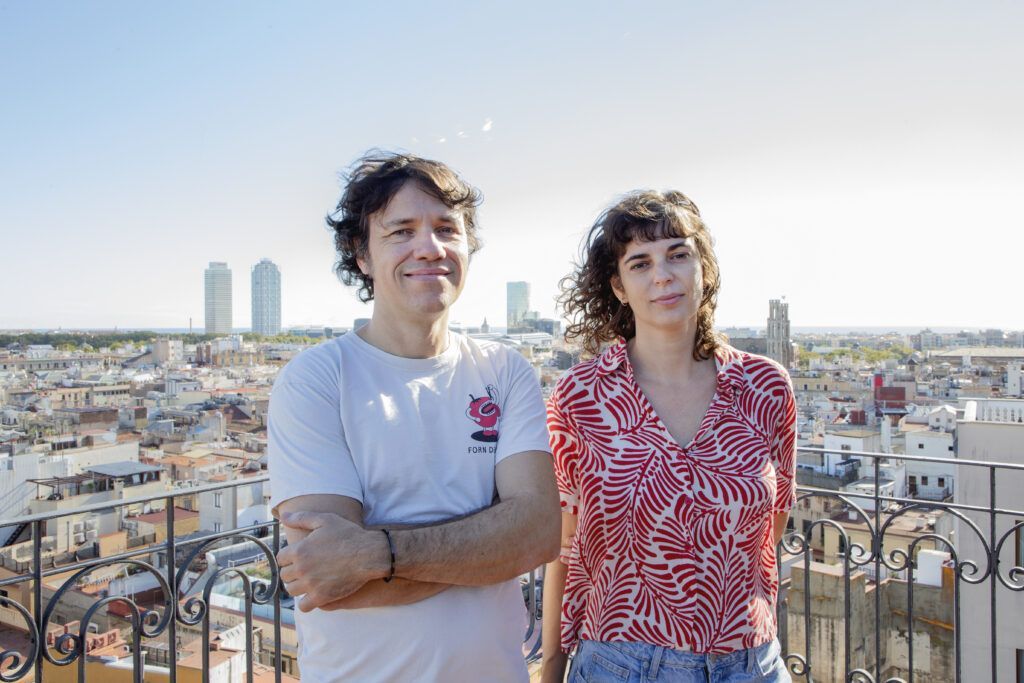
“Experimenting at the interface” is a new debate block of the Revers program that aims to open a space for reflection and dialogue on the dynamics, characteristics and objectives of the relationships between knowledge practices and methodologies of technological, artistic, academic and scientific development.
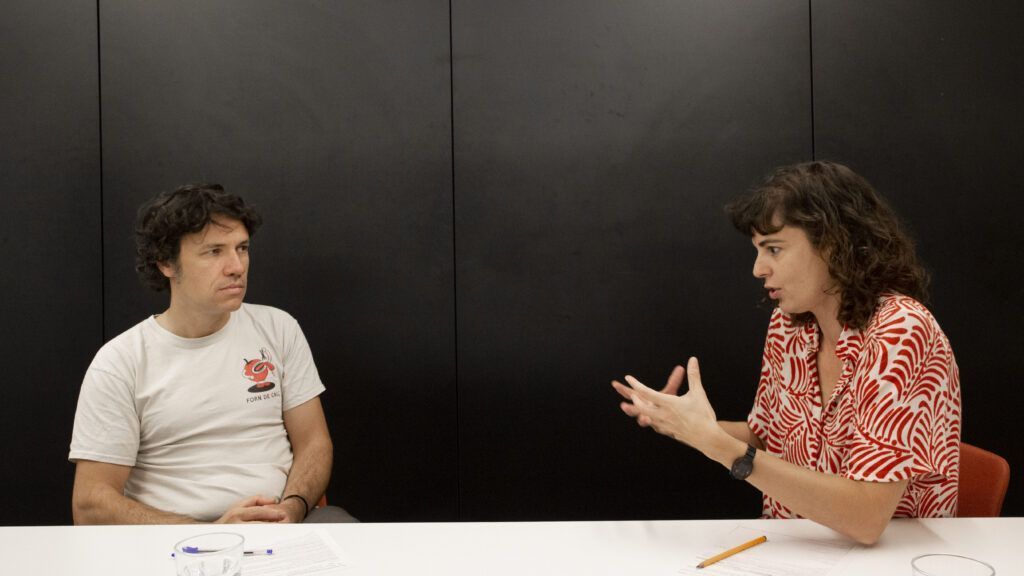
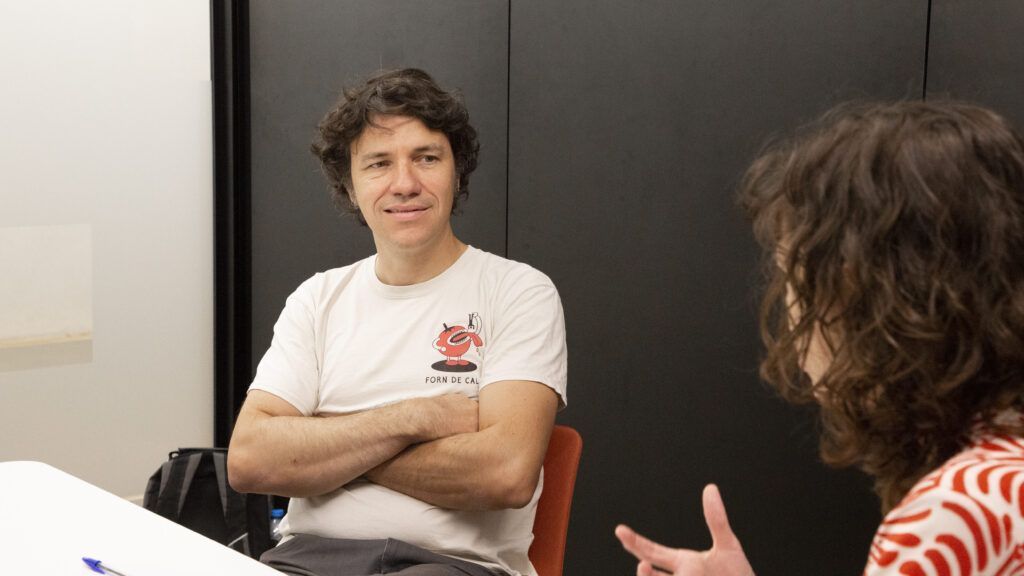
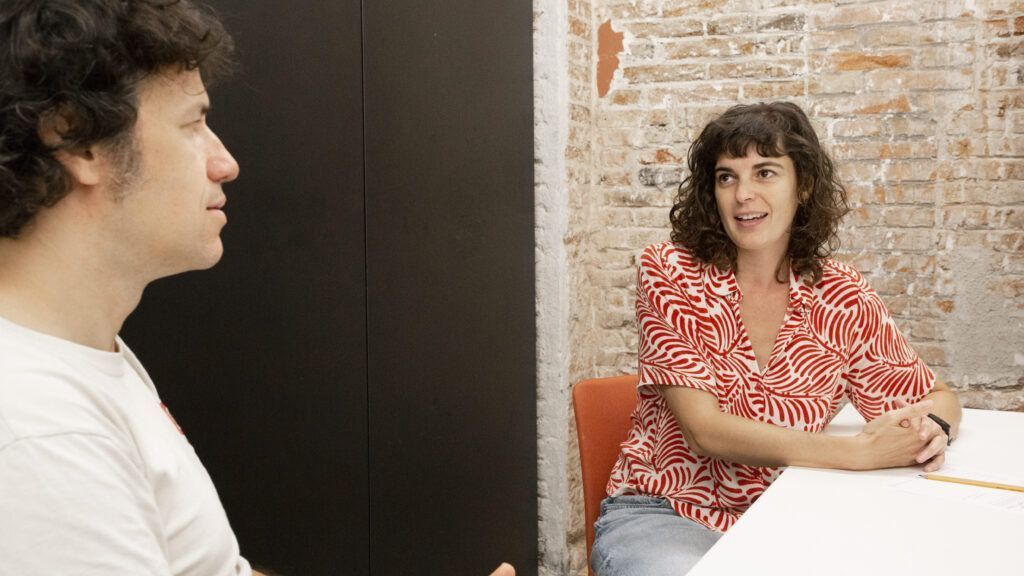
In this conversation, Joan Llort and Mariona Moncunill reflect on how to navigate symbolic and knowledge capitals in the context of transdisciplinary practices, and analyse the tensions, asymmetries and potentialities that arise when crossing borders between disciplines to become spaces for the generation of new knowledge.
At a time when the hybrid relationship between science and the arts is emerging as a relevant space from which to question classical paradigms, the conversation also addresses the power dynamics that intervene in the configuration of these relationships, the need to distribute resources, establish frameworks and conditions that facilitate collaboration with the aim of building collective knowledge, critical and open, capable of responding to the challenges of contemporary society.
Joan Llort is a Ramon y Cajal researcher at the Institute of Marine Sciences – CSIC. His research focuses on the influence of atmospheric particles on marine ecosystems. He also regularly contributes to projects hybridizing art and science with the aim of approaching oceanographic and climate research from alternative aesthetic and conceptual perspectives.
Mariona Moncunill combines artistic practice with research and teaching at BAU University Center of Arts and Design of Barcelona. Her research straddles the sociology of culture and artistic research, with a strong interest in the conditions of possibility – both in research and in professional practice – and methodological reflection.
Joan Llort: I have the feeling that in transdisciplinary collaboration initiatives there is something that has to do with power: why does scientific discourse always have more authority? Often the artist asks you to “take some of your time”… And this relationship of asymmetry generates from the beginning a dynamic that ends up being, more than a collaboration, a consulting. I like to break this dynamic with artists, but I’m afraid that certain researchers like this authority because they think that the scientific voice is really more “true” or more valid than the others.
Mariona Moncunill: I think there is a very important difference in whether the artist or the artistic researcher is protected under the academy or comes as an individual professional, because here there is a double legitimacy. On the one hand, that of the field in question (science, arts, humanities, etc.) which has a very clear social hierarchy, and on the other, the legitimacy that the fact of being protected by the institution and its procedures gives you.
I think that with these attempts at dialogue between disciplines, what is needed, in many cases, is that there are no specific productive objectives or results, because these are very different for the artist or the scientist. This helps a lot. But, of course, who can afford to have time to simply dialogue until something happens, and even more so in the academic context?
J.L.: Many of us complain that we don’t have that time to investigate because all we do is justify projects. And this time that we lack is what generates confidence. Once you’ve achieved it, I may not understand what you’re doing and why you’re doing it, but I trust you…
M.M.: Some artists such as Paula Bruna and Sílvia Zayas explain this very well: how this dilation of time generates friendship and how the most interesting and powerful projects, those that are very well hybridized and you don’t know if they fall more into science or art, tend to come out because there is a very intense relationship behind them.
These are initiatives that often escape a little from the institutional context. In this regard, I have the feeling that artists have a greater initiative of their own regardless of whether the context supports them or opportunities. This means that they can find a lot of tangents to work on, and part of their creativity goes through that. I don’t know if there are so many scientists who allow themselves, for structural or personal reasons, to do science beyond whether or not they have a contract or institutional support.
J.L.: Related to this, one thing I really like about artists is that they reflect on topics in the field of science that they could not do if they did not come from a personal or “autonomous” reflection. Very often the critical point of view comes from a freedom that academia does not allow, either because you don’t have time or because only what is efficient and brings funding is prioritized. This tension is something I miss in science. I approach the artistic sector because I find that all the critical sense that we apply in scientific methodology is not used to question, for example, the funding we receive. There are many people in the scientific world who still do not accept that much of the funding responds to a political agenda.
M.M.: From the cultural or artistic field we have a lot of interest in the cultural and social construction of things, political interpretation and representation. In other areas, this perspective may be a little lacking, and it is one of the points where I think the art world can contribute a lot. For example, we are sometimes surprised, from an artistic practice, how a digital tool is chosen, without considering how it affects the results of a research or how they are interpreted.
I really like to read old scientific texts, from the eighteenth or nineteenth century, and see how poetically they wrote and how they did not cut themselves when referencing poets or painters. The tone is also more personal and surprisingly more situated than in current scientific papers; and you can glimpse how intertwined everything is and you can intuit a little better the politics of representation that are at stake.
J.L.: Personally, I have a moral problem with scientific literature: right now there is a bubble, no one is reading and everyone is publishing excessively. I try to publish things that people read, I panic to publish an article just for the sake of publishing and that no one cites it.
The scientific construction is a common construction. For example, many people in environmental science believed that science could change things. That all that was missing was data and knowledge of the Earth system. But there comes a point where we see that this is not the problem. Climate change is understood, it is not a scientific problem, but a political one. When you see that you don’t have an agency, it generates a lot of frustration and makes you need to explore other ways or spaces where you can talk about all this. That said, I don’t think that art should be given the responsibility of convincing people. I remember that some time ago the justification for the first grants for collaborations with artists was that art “has emotions”.
M.M.: This comes from the lack of knowledge of what the other can do or contribute, and that can lead to commissions that are based on uninformed prejudice. Then the dialogue is no longer horizontal. You need humility when you approach the other, to understand what he is doing and why he is doing it, because if not, you fall into the utilitarian. You have to recognize the expertise of the other, even if it escapes you. It should be taken for granted that the knowledge of others is valuable.
J.L.: Stopping on the subject of value, I think of another problem of asymmetries: in the Sea Science program of the Institute of Marine Sciences, we would like to involve the nearby neighborhoods. The problem is that if I get a project to work with “non-scientific” citizens, the money will be given to me. So I’m marking an unequal relationship from the beginning, because I have the money and “them” don’t. It would be great to be able to say: “I will not manage this money, it will be managed by this neighborhood association”, because it is a way of sharing the agency and starting from a symmetrical place in which we can work.
M.M.: I love the idea of really transferring resources as you propose, and transferring the decision of how to manage them. It would seem like a big step to me. It’s great that someone wants to work with people or groups that aren’t legitimized by their own field, but how is it possible that we always have to wait for someone to trust us instead of being in a system where it’s guaranteed?
J.L.: There is also a shift in value in projects by large institutions that work with artists and use the prestige of the institution itself to contact other similar science or art entities. This value of prestige between institutions has nothing to do with the value of funding, which is still very limited by artists.
M.M.: It is very clear proof that people are not believing in this. If one institution really believes that the other has exactly the same to contribute as you, the resources would be distributed equally. But this is not the case. We come from a whole history of precariousness in the art sector that seems to be convenient because it lowers costs. In all European projects that touch the art world, in the end only the drains reach the artists.
J.L.: In physics we often talk about initial conditions and boundary conditions. It is very important to know your initial conditions: to know your privileges and to know from where you are doing it. There is an asymmetry that we will not eliminate, but being aware of it means that perhaps we can ensure that this does not end up impacting the result too much.
M.M.: Totally. And beware, I think we have other privileges from the art world that, hopefully, we could pass on more easily. Artistic practice detached from academia is much freer: beyond the material restrictions and violence of the society of which we are a part, you can talk about any topic and you can link yourself to any person and field of knowledge. There is an openness that is a luxury that practically no other area of knowledge has.
J.L.: It happened to me. We were talking for a long time with an artist and there was a point I told her: “We have to do something, I guess you have to produce something”. And he replied: “No, talking is already something”. It has happened to me with other artists who told me that what they were really interested in is the character of the scientist. Well, too!
M.M.: When they tell you “I’m interested in you as a character”, it’s a strange starting point that could generate conflict… What it really explains is that there is a void, a void that may not be bad as an open starting point, but that may lead to a lost in translation of expectations.
The important thing is what is verbalized. The artist and researcher Lúa Coderch says that one of the first things that should be done in these relationships is to make explicit what are the objectives you have when approaching one person or another, and even the prejudices. But it is very difficult to exercise this self-analysis.
J.L.: Another question that seems very relevant to me is how to make the institutions really interested in the process. Now it’s very fashionable to do art and science collaborations, and when they tell me “how cool” I think they only think about the final product that has been successful. If an institution wants to carry out an art and science project, it must be informed of what contour conditions it must put in place for this to work. And that it works for both parties.
You often explain the projects that work and that have repercussions or public visibility. But maybe that project was a bunch of problems that you manage on your own and in the end, also in a bunch of coincidences, it goes well and is successful in terms of visibility.
M.M.: In scientific and academic publications, negative results are not usually published. You don’t explain that you have tried to apply some methods and they have not worked. It would be very necessary to explain it so that others can learn from it: we have all these experiences that have been a disaster, and it is useful to know them and know why they have not worked.
From art the error is recognized much more. I think it has been understood that this part of the story can be interesting. Sometimes we have deadlines where the result must be shown in an exhibition and, if it doesn’t go as expected, we have learned to turn it around to be able to explain this process.
J.L.: This is a very nice thing that I discovered at BSC with computer engineers, which is what they call debugging. When the code has a problem or error, they fix it in community. It is very transparent and there are no trials.
M.M.: Regarding the debate on the digital world and how it affects research, which was one of the starting points of this conversation… I don’t know if I’m old or reactionary, but it’s very difficult for me to think of the digital environment as something apart. I don’t know how to separate it. What does not happen in the digital environment? Especially if you think about academia. McLuhan’s premise that the medium is the message is still valid. We should keep this very much in mind and we don’t. Just as it is put in the articles who finances you, perhaps it would be interesting to put all the media that have shaped our research, because they are shaping it. What worries me about all this are the political and social implications of all these tools that we use and that are made invisible.
J.L.: For me, there is a part that I don’t understand as digital and that is important to live it because otherwise you are building an environment that is very far from physical reality. Right now there is an overfunding of the technological and software part. I always give the same example: the great European project to generate a digital twin of the Earth (Destination Earth) has a lot of money to develop a brutal model, but if you don’t have a network of physical observations, how will you know if that is working?
M.M.: Do you think there is a difference in critical consciousness regarding the results between scientists who touch on the mechanical part and those who only work with the data directly?
J.L.: I think there is a lot of difference. For example, I did a modelling thesis, but I went to sea. When you use that data, you say to yourself: “Wait, that day we got up early, the sensor was not working, maybe this measurement is biased”. Then you realize the value and at the same time the limited representativeness of that measure.
M.M.: Yes, in the digital environment, for most of us, it seems that we do not need to know what are the mechanisms that operate, which are physical and, therefore, political. We have some tremendous black boxes.
J.L.: And this gets even worse with artificial intelligence.
M.M.: Yes. We talk a lot about technical innovation, but very little about creative, social or political innovation, which should go hand in hand and don’t go there.
This conversation is part of the Revers programme, which has the support of the Department of Culture of the Generalitat de Catalunya and aims to activate debate and generate knowledge around various aspects that affect the field of digital culture.
The series proposes duo conversations between creators, researchers, developers, managers and other agents in our context to explore, from different perspectives, key issues that cross digital practices.
In this third thematic block, dedicated to reflecting on the relationships between different knowledge practices and development methodologies, Eurídice Cabañes, Joan Llort, Mariona Moncunill and Fran Iglesias participate. The conversation will be opened to the public in a public debate on December 9, 2025 at 6 p.m. at the Antic Teatre.
This conversation has been edited for clarity and conciseness.
