

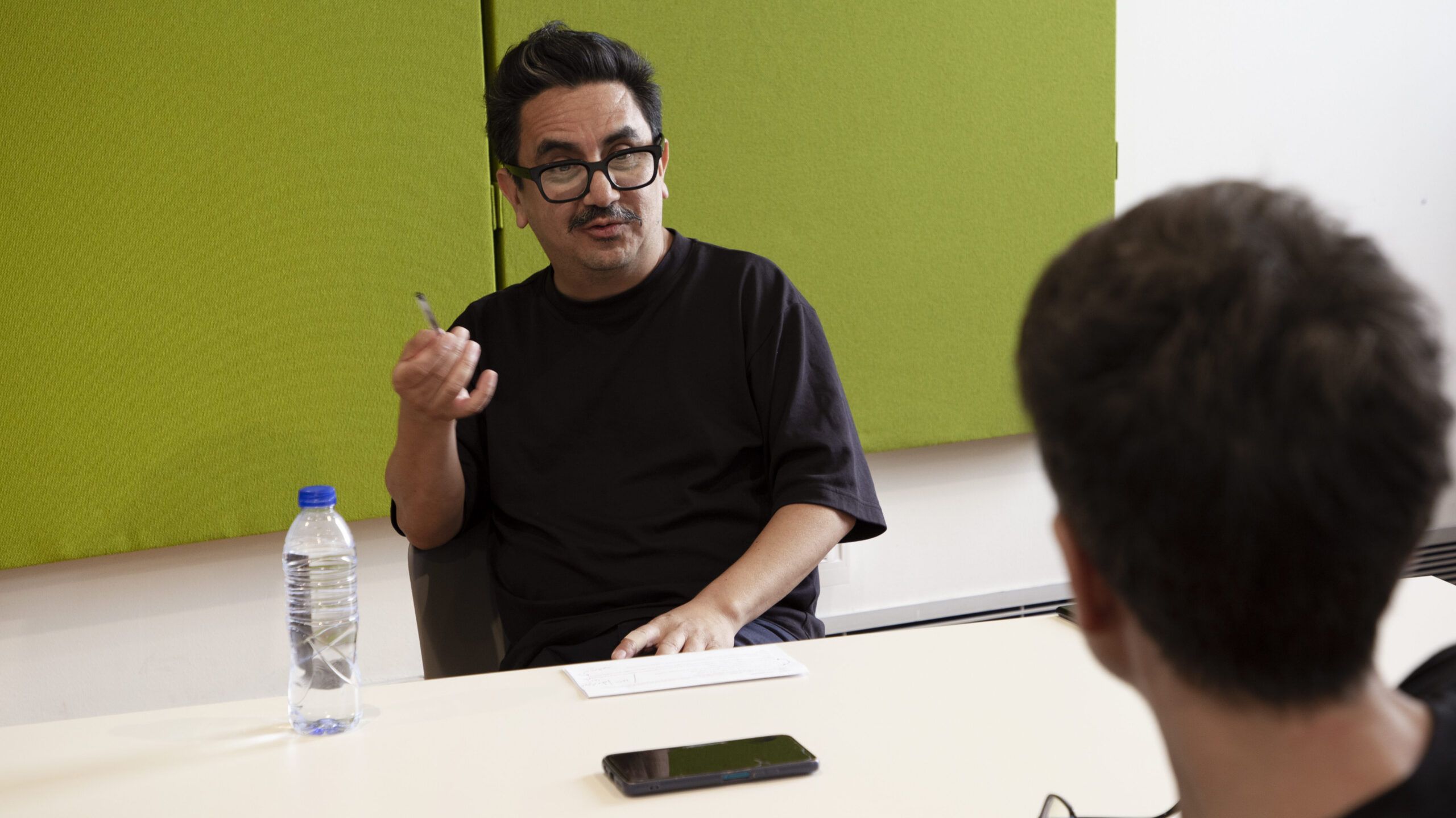
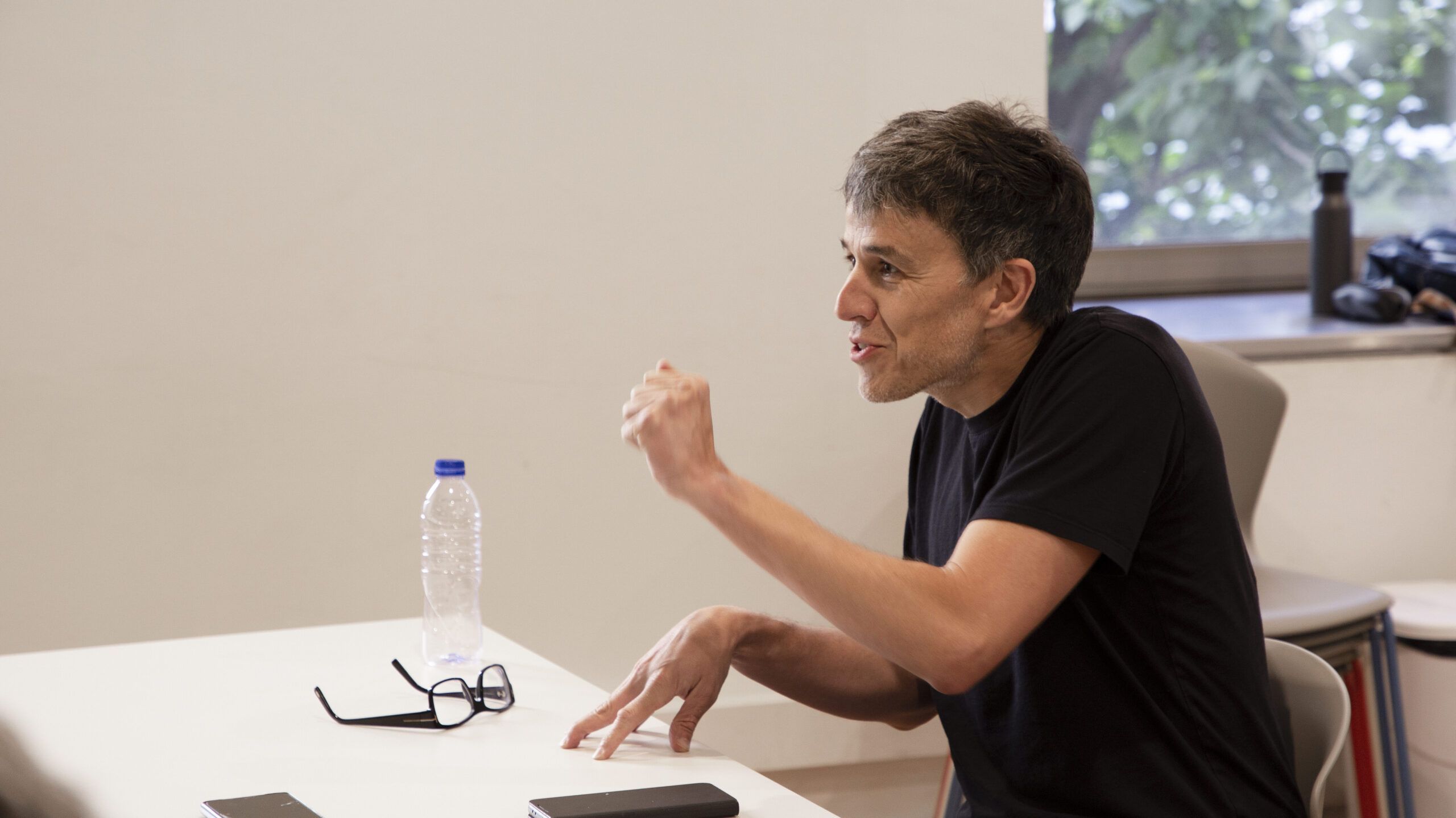
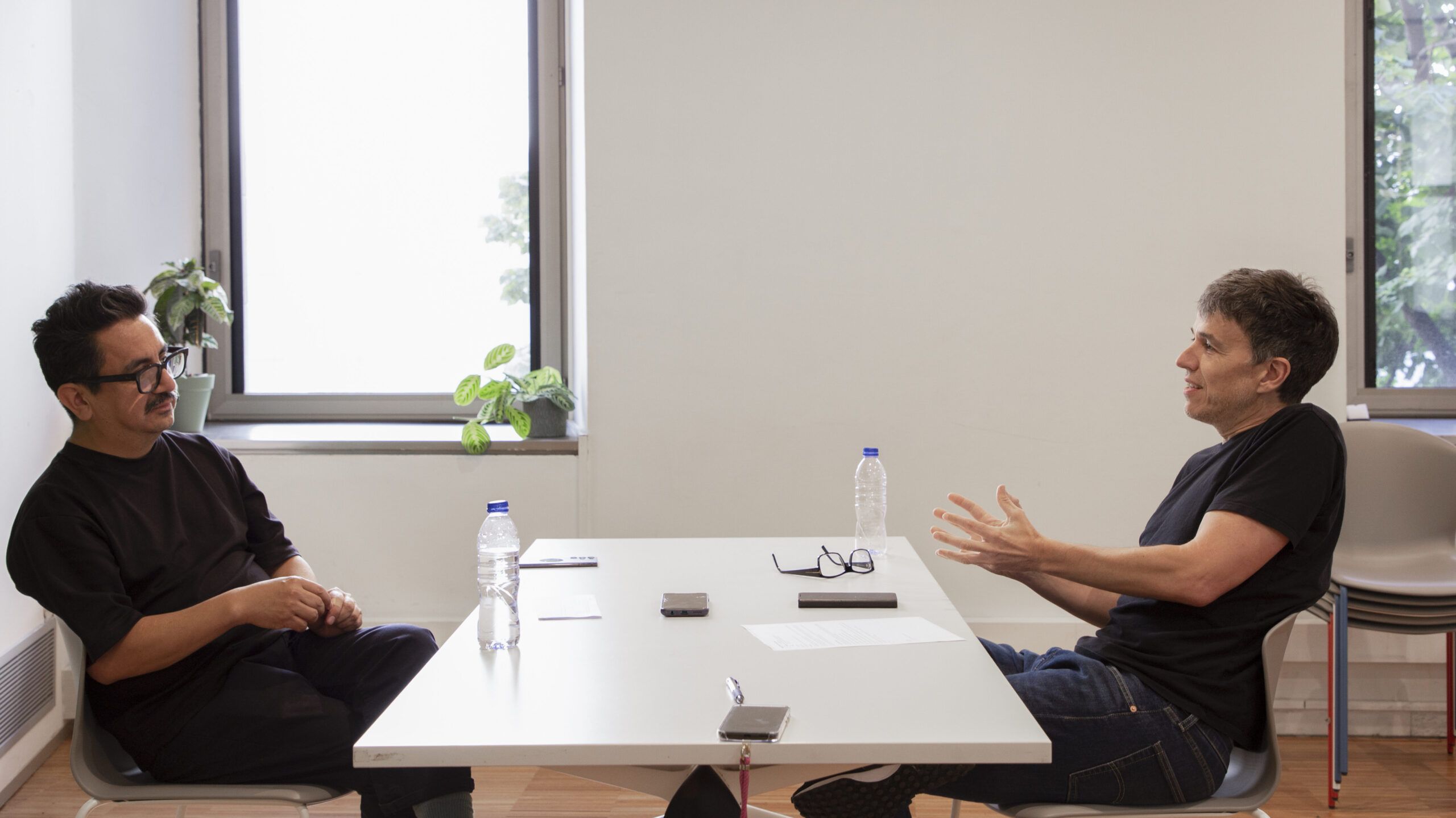
Jordi Sellas and Efraín Foglia kick off the Revers programme with a closed-door conversation at the Centre de Cultura Contemporània de Barcelona (CCCB) on the changing contours of digital culture. Promoted by HacTe, the first thematic cycle of Revers for 2025 proposes to discuss how this field transforms contemporary cultural production, what technological values it expresses, what new economies it generates and who is part of it. For nearly an hour, the guests address key issues such as the concentration of platforms, the distribution of content, technological imaginaries and generational changes in the way culture is created and consumed, moving from techno-optimism to the current tensions in the sector.
Sellas is a journalist and manager of cultural companies. Founder and director of Layers of Reality, he is also the current artistic director of IDEAL, the Centre d’Arts Digitals de Barcelona. Between 2013 and 2016 he was Director General of Creation and Cultural Companies of the Generalitat de Catalunya. Foglia is an undisciplined designer, researcher and teacher. He is the scientific coordinator of the Medialab of the Open University of Catalonia (UOC). Her work is positioned at the intersection between design, grassroots activism and network technologies.
Jordi Sellas: If we want to talk about digital culture, I think the first thing to do is to delimit the perimeter of this concept. When we created the program Digital Generation on the radio (started in 2002 on Ona Catalana), we titled it that way because we saw that we were the first digital generation in history. In other words, the first generation – those born in the mid-70s – who had lived all their lives knowing that there were computers in the home that could intervene in our daily lives in many ways, and that generated a two-way interaction. It was the first time that the screens answered you. This first generation also represented a different type of culture: it related differently to the world of creation and creativity. Making this extensive, digital culture is all that creation in the cultural field that requires the mediation of computing or computing in order to be created.
Efraín Foglia: For me, this idea of the perimeter of digital culture has two phases. The first, which is linked to what you have narrated, Jordi, which is where the descriptions of the perimeter of digital culture would fit. But then another phase appears, which would be the “non-perimeter” of digital culture, because for recent generations a series of paradigms of this first cycle of digital culture have really been metabolized. Let me give an example: recently, if we talk to someone very young who is involved in this field, and that is a large part of the population, it is already difficult for them to have their own reference for this paradigm shift. This digital culture is basically their universe for them, as television was for us at the time. For me, what transcends this perimeter, or that is being left out, is what is shaping this second wave of digital culture. And also a very important historical change is that we first had a digital culture and then a networked culture. Now we have surpassed digital, and we are in a networked society.
J.S.: Yes, when we enter this “connected world” many things change, for example, the distribution of content. All those who have been functioning for decades as guarantors of new cultural content fall and we enter an apparently wonderful world. Those of us who are dedicated to it thought that it was an environment where you can’t put doors. Then it begins as a time of techno-optimism where it seems that everything would be more open, distributed and democratic, and the slap in the face that we all take comes when we see that, if before we had dozens of companies that controlled the entire content industry, now we have 4 or 5. We see that these gatekeepers of access to content are now a very restricted amount of people.
E.F.: If we talk about the transformative capacity of digital culture, we have to ask: transformative for whom? We, in the first decade of the Internet, were extremely enthusiastic thinking that we could reread international geopolitics, including the cultural industries. Now, in 2025, we realize that it is the same geopolitics, but with new toys that have been swallowed up by these industries. In the case of creative environments, all this enthusiasm has turned into disappointment in some cases, but in others into an exercise in critical analysis and evolution towards new industries.
J.S.: Everything has changed so as not to change, he is from Lampedusian. Movies are still 90 minutes or two hours long, and the format hasn’t changed much in 100 years. The lane on which it circulates has changed, now they are not just cinema screens where everyone queues to see them. The same goes for songs, books, museums… In reality, we are seeing that the units of creation of a cultural nature have not changed so much, the only radical irruptions that are difficult to fit in are video games, immersive content, virtual reality glasses that already break the rectangular screen… All these things that we don’t know how to fit and we fit them into this tailor’s drawer that is the perimeter of digital culture, which is where new things happen.
E.F.: There are statements by Bad Gyal, Cecilio G and Young Beef who considered —I don’t know if they still consider it, because their perspective must have evolved— that stopping working with a record label and publishing on YouTube or Instagram was a revolutionary emancipation. The plot is exactly the same as when you listened to an alternative Motown record label that at the time said “we don’t belong to Sony, we are rebels”. And that’s where I wanted to go with what I was saying about the new generations, who no longer have this enclave between what was before and what it is now. Those of us who have a longer career take it for granted that it has been understood that YouTube, Instagram or Twitter is exactly the same, but from the twenty-first century. On the other hand, for this generation, in terms of production, access and construction of their audiences, they see it as incredibly revolutionary. The generational change means that what we see from a critical look at big industry, many very young people see it as a space of freedom. In the same way, in retrospect, in my generation the car, coming from the working class, was a symbol of freedom. Right now the car is a symbol of the destruction of the planet.
J.S.: This is where this “oligopoly of discovery” comes in. How do you discover a new film, song or exhibition that you will like today? We have mutated: there was an area very much controlled by mass media, in the hands of a few, which defined what should be done or consumed, media that marked the line of what was culturally “good”. They were editors of collective cultural tastes and it was very clear how they worked. In 2007-2008, from the moment in which communication habits change through the networks, and everything that we discover in the cultural and creative field passes through this kind of massive centrifuge of tastes and opinions of different people, it seems to us that suddenly the users, society, have the power to say what is right and we enter another techno-optimism, just like the one in the late 90s. But what ends up happening again? The kick is coming again. All we have done is change publishers. Before the editor of El País, La Vanguardia, The New York Times or the BBC you knew who he was, and now the editor is Mark Zuckerberg or Elon Musk. It’s more subtle, it’s not so obvious. That’s why I like that the social network has evolved to be called social media, because that’s really what this oligopoly of discovery has become.
E.F.: It seems to me that another paradigm shift is that the current media network has been able to use very well a value that comes from the political left, which is that of the community. If you look at Airbnb, Uber, Spotify… it is a mixture of imaginaries between communitarian, rural, anti-capitalist practices… with those of hackers, who understand that they are a community and not consumer individuals. And they metabolize it perfectly. The imaginary of Airbnb is: “we share the house so that you can meet the people of Cadaqués”.
J.S.: And there is another thing that, traditionally, had happened, but that the world of digital culture, and in general of everything digital, has taken to the extreme —in which I think we will all end up hurting ourselves—, which is a new culture of the subscription economy. What was a typical model of theatre, opera or a magazine has been moved to digital. And those who have driven this change have been porn and video games, two large industries that have been the first to get people to start paying for content on the Internet.
This conversation is part of the Revers programme, which has the support of the Department of Culture of the Generalitat de Catalunya and aims to activate debate and generate knowledge around various aspects that affect the field of digital culture.
The series proposes duo conversations between creators, researchers, developers, managers and other agents in our context to explore, from different perspectives, key issues that cross digital practices.
In this first thematic block, dedicated to exploring the perimeter of digital culture, Mónica Bello, Efraín Foglia, Antònia Folguera and Jordi Sellas participate. The conversation will be opened to the public in a public debate on October 14, 2025 at 6 p.m. at the Antic Teatre.
This conversation has been edited for clarity and conciseness.
Thanks to the Centre de Cultura Contemporània de Barcelona (CCCB) for the provision of the space that has made this meeting possible.

