

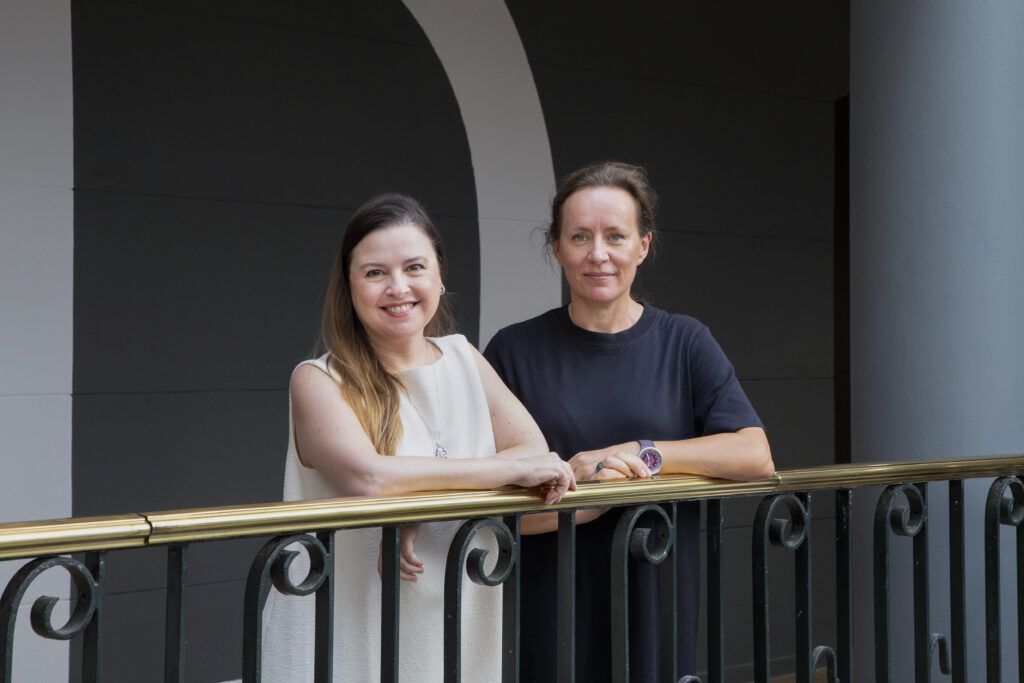
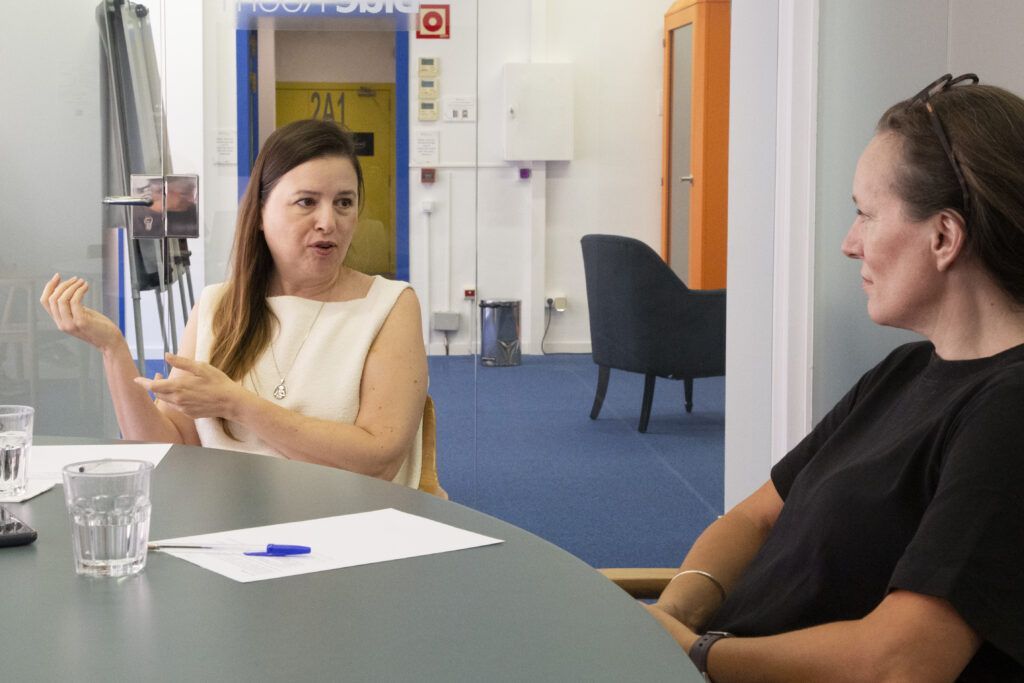
Antònia Folguera and Mónica Bello are the protagonists of the second conversation of the program Revers, a space promoted by HacTe that seeks to promote critical dialogue around the contours, potentialities and contradictions of what we call Digital Culture.
This meeting is part of the first thematic cycle, inaugurated by the conversation between Jordi Sellas and Efraín Foglia, which proposes to delve into the diversity of impacts of the paradigm shift that digital culture has brought about in contemporary cultural production. The session navigates from the emergence of independent art scenes to the role of video games, microtrends and economies linked to new technologies. Folguera and Bello put on the table key issues such as the transformative capacity of art, resistance to standardization, hyper-personalization and the need for artistic creation to access technology before the business takes over.
Folguera is a curator and communicator, and creates content for conferences, podcasts and radio programs. Her work moves through the fields of digital art and culture, communication and electronic music. She is the curator of Sónar+D, Sónar’s creative technologies congress, and is part of the curatorial team of Eufònic (Terres de l’Ebre), and of several projects in which she acts as an independent curator. She is also co-founder of the XRCB (Community Radio Network of Barcelona), a community, ethical podcasting platform for the common good.
Bello és historiadora de l’art i comissària amb base a Barcelona. Del 2015 al 2025 va exercir el càrrec de directora d’Arts at CERN, a Ginebra, on va dirigir iniciatives com residències d’artistes, comissions artístiques i exposicions, facilitant les col·laboracions entre creadors i científics i garantint la sostenibilitat dels programes i l’estratègia cultural del Laboratori. Durant la seva gestió, Arts at CERN va rebre el Premi STARTS 2024 a la Innovació Col·laborativa. Entre alguns dels seus projectes curatorials més destacats es troben l’exposició inaugural de CERN Science Gateway (Ginebra, 2024), Dark Matters (Melbourne, 2023), el Pavelló d’Islàndia a la Biennal de Venècia (Venècia, 2022), Broken Symmetries (itinerància europea i Taiwan, 2018–2021) i l’Audemars Piguet Art Commission per a Art Basel (Basilea, 2018).
Antonia Folguera: I think that when talking about digital culture we have to take into account the different scales that operate in it. We cannot mix and put into the same bag things that have a completely different scale, such as the video game industry or that of the artists who use the video game as a medium or tool. They are completely different economic scales. In addition, they are scenes —using a word from the world of music— that have nothing to do with each other and do not even speak to each other. And that’s okay, they don’t have to have a relationship.
Within what would be digital art here in Barcelona, there is a scene, and it has been there for 30 years. And this scene has always been small, no one has paid attention to it for decades. We’ve done it our way, independently, with what you scratch here and there, and many of us have two jobs: one commercial for the masses and another with which you don’t make money, you even spend money on it. That’s why I like that right now digital culture is being listened to, or digital art, that attention is being paid to a whole generation of creators that for years has been very strongly ignored in the city and in Catalonia. I think this attention is good and also deserved.
Mónica Bello: Yes, there is a great legacy, and many things have fallen by the wayside. Here in Barcelona, artists such as Joan Leandre and Jodi (Joan Heemskerk and Dirk Paesmans) worked. I think they began to listen to us when life on the net became inevitable, when we were already totally immersed in it, and there was such a great and paradigmatic social change. The question of what digital culture is today I think is very difficult to define. It is contemporary culture. We are digital. But what does digital mean, at least? I think the most interesting thing now is that it happens a bit like with the way people dress and act: everything is mixed up and no instruction or prerequisite for being something is accepted. This is mashup and post culture. We are all “post-something” and this is very interesting because we have already lost the ability to define things. Things grow and are very malleable.
A.F.: If we go to today’s local scale, digital artists are Mónica Rikic, Anna Carreras, Playmodes, Mario Santamaría or Joana Moll. Not all of them are “techies”; some work from reflection, thought, and deep research into the mechanisms of the digital. I think this is relevant: it’s not just about programming or soldering cables, but about the approach and the way to convey the issues to the audience.
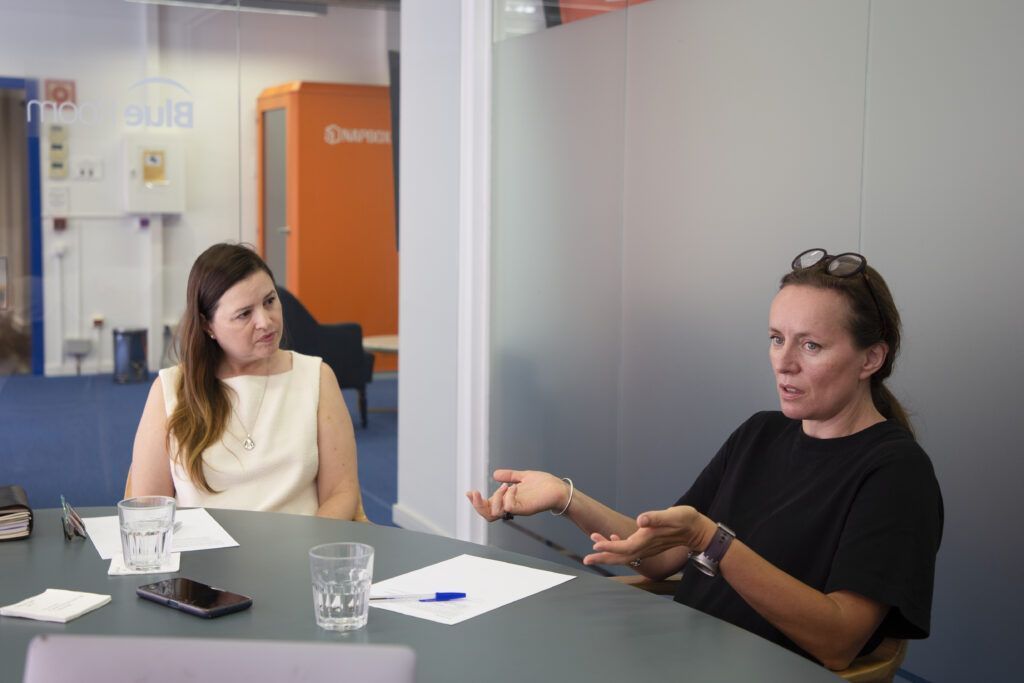
M.B.: I think it would go even further. It is storytelling and the creation of worlds, which is very present in art today, and is very affected by the awareness of what we call “digital”, a term that people born after the 90s no longer use. I think that narratives and the construction of narratives about the digital call into question our idea of time. And this is where we find ourselves with the need to define what digital art is and we come to video games. Video games, gaming environments , transcend temporalities and bodies: they offer many possibilities. The young people closest to me perceive time differently. Maybe they haven’t put the emphasis on it yet, they don’t try to define what this means, but time has changed, the concept of time, the way we live time.
A.F.: Totally. And the other thing about the temporalities that we are experiencing is non-linearity. For example, being in multiple conversations at once, in multiple places at the same time. And I don’t know if we are ready to live non-linearly, living different realities at the same time and jumping from one reality to another constantly… Maybe young people, yes, I don’t know…
M.B.: In addition, 15 or 20-year-olds know that they have multiple options, while we usually choose one of all these. I’d like to have time to observe more everyday habits, those things that a lot of young people do, like listening to a fast-paced WhatsApp audio or watching several Youtube videos overlapping at the same time.
A.F.: There’s also this issue of hyper-personalization, which I don’t know how good or bad it is. That is, whatever everything is so tailor-made, whether you ask for it or not. I like that there are a whole series of tools that, on an artistic level, allow you to easily create what you imagine or what you don’t even imagine. But also, returning to the algorithmic part, there is the issue of information bubbles. If everything is so personalized, what world do you live in? You’re completely disconnected from the rest. We live in smaller and larger worlds at the same time. For example, one of the things that has always freaked me out about the world of digital culture is the popularity of the world of ASMR. Almost 10 years ago, we invited Sónar+D to Sónar+D on the music platform Bandcamp and they told us that one of the most searched labels on the platform was ASMR. In other words, it is something very rare, but it unites millions of people and seems, at the same time, to go unnoticed in what would be the
M.B.: Do you think it’s a kind of counterculture or a response to atomization?
A.F.: I think it’s a response to atomization, because I’m not very sure about the concept of counterculture right now. It is certainly not the same as in the 80s or 90s. It must be said that now there is this mixture that I love: it is not frowned upon that you like 30 different things, and besides, you mix them together because you think they work together. And this happens in music, in fashion, in everything. Then there’s also this thing about microtrends that last a short time. It is no longer that they are “micro” because they correspond to a small group of people; It’s because they burn fast. I think that complexes, manias, and urban cultures as they were known have disappeared.
M.B.: I believe that there is a counterculture, but it is micro. And if it does not last in time and decay, there is no longer this fury. […] I think that after the pandemic, digital consumption became soft. The platforms where we consume content build our habits and offer us a smooth way to understand cultural legacy or stories. You go to Netflix and series, movies, etc., want to make you a good citizen. There are no extremes. There is a curation of content where many things disappear. We should start paying more attention to curating the content we consume, and how this shapes us as individuals and society.
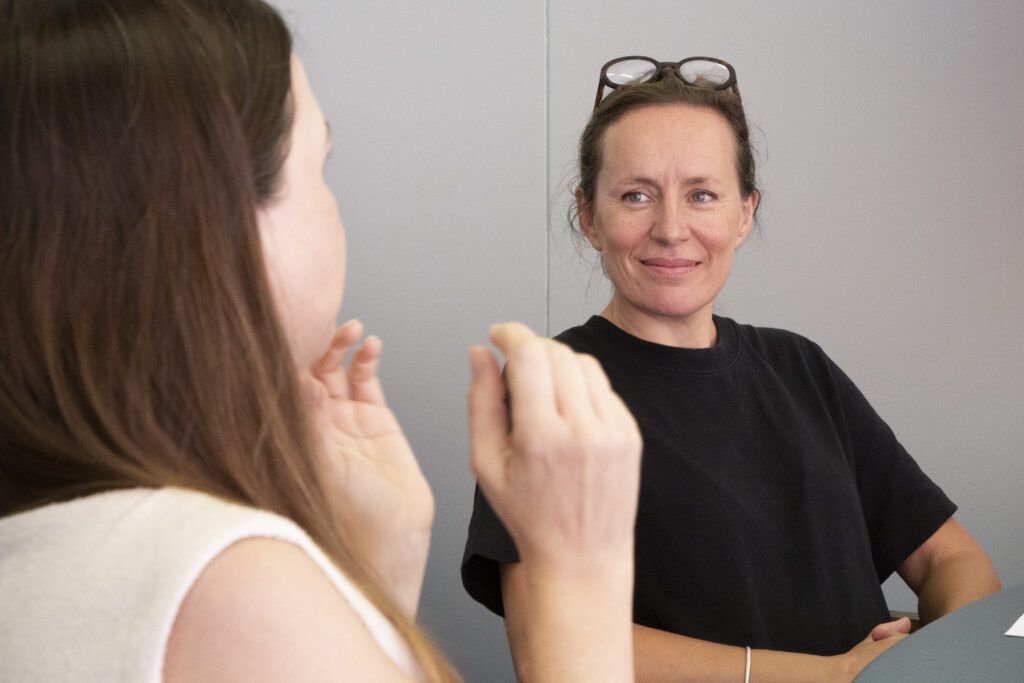
A.F.: A paradigmatic case of this is Spotify. Now music popularity is measured in streams on Spotify; The listeners you generate on this platform are the standard. But it is not the largest or the most listened to music platform. The biggest platform is YouTube, because there is music that only exists there, and even if it has ads, it is free. I think nothing is accidental, and this is where the conspiracy theory activates me: who decided that Spotify is the standard?
M.B.: The way in which the canon is generated is very important, but what interests me most is the habit of living in this reality that we create. Do we want to discuss which economies are emerging? Well, I don’t know if there are economies that arise from the creation of digital art today.
A.F.: I would say no and yes at the same time. I would say no because digital art works basically the same as it did 20 years ago: in festival circuits, biennials, conferences… Then there is a small part that exists in the world of galleries, which is growing slowly. There is also the field of immersive performance, which I think is not always art, but contains art, because the people who build these worlds are artists, even if they do not project their personal vision.
And then there’s the whole blockchain world where there are artists selling. During the pandemic, a lot of
M.B.: This says a lot about the cultural production that we have today and that leads, on many occasions, to opportunism: “this year we have to do this; next year, something else.” It is a fact that worries me in terms of the distribution of ideas and how new ideas can emerge as a result of creativity or other motivations. That is why it is vital that art has early access to technology […]. It cannot be that platforms offer us a type of content or very limited frameworks in which we can intervene, when there is a whole universe that is there and we do not have access to it.
This is the danger of art and one of today’s challenges: resisting standardization and atomization, and continuing to defend that art has a transformative capacity.
A.F.: Totally, the sooner a technology appears, we make art with it. It is crucial that art intervenes before the business takes over.
This conversation is part of the Revers programme, which has the support of the Department of Culture of the Generalitat de Catalunya and aims to activate debate and generate knowledge around various aspects that affect the field of digital culture.
The series proposes duo conversations between creators, researchers, developers, managers and other agents in our context to explore, from different perspectives, key issues that cross digital practices.
In this first cycle, dedicated to exploring the perimeter of digital culture, Mónica Bello, Efraín Foglia, Antònia Folguera and Jordi Sellas participate. The Revers program will also feature a public debate on October 14, 2025 at 6 p.m. at the Antic Teatre to open the conversation to the public.
This conversation has been edited for clarity and conciseness.
